Mardi Gras and Ash Wednesday

It is Mardi Gras eve in south Louisiana – or Lundi Gras – and it’s raining.  I’m tucked inside, with no real desire for paradegoing either tonight or tomorrow. I enjoy parades and beads, but the weather doesn’t look inviting, and wet beads are pretty yucky.

Yesterday at church, it was mentioned that Mardi Gras isn’t on the Christian calendar.  Of course not, but it’s certainly on the Louisiana calendar!  Our French and Acadian (mostly Catholic) heritage ensures that, and I pause to think about this custom of “one last fling” of indulgence before the penitential season of Lent. While some go far overboard with indulgence, most of the southern part of the state simply eats too much, drinks too much, and fights over cheap plastic beads thrown by people on floats who have been drinking too much since the early morning.  It’s an excuse for a party, and we love parties, and we love fun.  Mardi Gras is fun and everyone puts aside their worries for a day.

MardiGras Mardi Gras parade in south Louisiana

Then comes Ash Wednesday, where some wear hangovers, some wear ashes, and some wear both. We come back down to earth, go back to the office, and usually spend some time in prayer and/or church.  In a sense, we experience two opposite extremes of behavior in a very short period of time.  Mardi Gras reminds us of the make-believe and the unreal (and often surreal); the “kings” and “queens,” the masking where we can pretend to be our alter ego.

For Lent, some give up chocolate, some give up crawfish, some give up coffee.  (I would posit that my giving up coffee would be more penance for those around me, but that’s besides the point…) I gave up “giving up” tangible things for Lent years ago, instead choosing to devote more time to a spiritual practice – or giving up a bad habit.  Last year I gave up whining, and found my life so enriched that I pretty much gave it up for good.  Ash Wednesday – and Lent – invites us to explore who we really are. It’s not about giving up a “something,” but rather about receiving something precious.

I wish you a safe and fun Mardi Gras, and a holy and fulfilling Lent!

A Shawl for Jean

My fingers move quickly, a bright red aluminum crochet hook dancing around and over and up and through soft green yarn.  I think of Jean, whom I do not know, but is sister to a friend and who has lost her second child.  My friend told us the story this evening at our prayer shawl gathering; her sister had lost her daughter (aged 54) several years ago and now has lost her son as well.  None of us could possibly imagine her pain, her grief.

It must be agony that only Divine Love can heal, and even that takes time.  I don’t even pause to wonder; I pull out the soft green yarn I bought a few weeks ago.  I didn’t know who that shawl would be for when I bought the yarn, I just knew that it would be for someone in need of prayer. Tonight, I know it’s for Jean, and I start to stitch.

I watch the hook, feel the yarn.  This is a particularly soft yarn, a single ply acrylic with long, subtle color changes in hues of green with occasional gold tones.  My hook slides around it like butter, and I am soothed by the simple act of yarn over, pull through. I think of Jean, praying for her, hoping to send just a little of this simple serenity her way.

I think of my own two children, both young adults. They make mistakes, and are trying to navigate the world in that collegiate neither-land between “home” and “on their own.” Sometimes they frustrate me, and sometimes they surprise me with spurts of maturity.  I give thanks that they are both healthy, vibrant, good and kind, realizing the rest of responsible adulthood  will come with time.  I realize that door has shut for Jean’s children, and I pray for her comfort.  I feel assured that she will have it; I also know it will not be without great pain.

My house is quiet, and it is nighttime, so I chant the 23rd Psalm very softly, the sound soothing much as the yarn.  I release these simple acts and prayers into the Divine, back to where they came from.  I feel a soft ripple in the Universe, and imagine wings as angelic helpers tend to Jean here on earth.

God Incarnate, Man Divine

It’s a quiet Christmas morning.  My husband David is cooking his amazing crawfish etoufee as a Christmas gift for his uncle, our daughter (home from college) is sleeping late, and we’ll see our son and the rest of our families later today.  Last night was a choral Christmas Eve mass followed by a  gathering of family and friends at my mom’s house. I spent yesterday running back and forth between office and home (happily within walking – or running – distance) cooking gumbo for the evening meal and taking care of business.

David and I were reminiscing about Christmas mornings when the children were little, waking us up to come and see what Santa brought. Those were good times, and these are good times, too.  A bit less frantic, with more time to cherish togetherness.  We’re lucky because most of our families are nearby, and we can spend time with nearly everyone over Christmas.

On this Christmas morning, I am thinking of words from the hymn All Hail the Power of Jesus’ Name: “God incarnate, man divine.”  After all, Christmas is the celebration of the birth of Jesus, the incarnation.  And the word became flesh and dwelt among us.

I’m reminded that the Incarnation means not only that God is with us, but also that God is in us.

Yet to all who did receive him, to those who believed in his name, he gave the right to become children of God—children born not of natural descent, nor of human decision or a husband’s will, but born of God.  John 1:12-13 (NIV)

We are children of God, having “God DNA” so to speak.  If we are children of God, how can we ever be separate from God?  We can choose to act as though we are separate from God, but that’s not reality.
God works a miracle every time a baby is born, bringing another child of God into the world. That child can never be separate from God.  It’s my wish this Christmas day and every day that we may all recognize our place as beloved children of God.

For a Christmas musical gift, click here and choose an mp3 file to play “Rock My Baby Jesus.”

Shawl Ripples

A prayer shawl warrior friend of mine (Margaret) recently completed her first shawl ministry project: A baby blanket for a preemie baby born to a friend.  Margaret had carefully chosen the yarn and the pattern, and committed herself to picking up a craft she hadn’t done in some years. Love and prayer for this baby were stitched into every yarn over, and once finished, she sent it to the family. I’d heard about this wee babe’s fighting spirit as we sat and stitched, and knew that she was wrapped in a wide community of love and support.

It seemed that the critical time had passed.  It seemed that this tiny fierce spirit would win out over her early and precarious start in life, but it didn’t happen that way.  A day after the blanket had been delivered, tiny V. slipped away from this world.  When I heard what had happened, I called Margaret.  I was thinking of something that had happened to me years before, when my own response was “what?  I didn’t pray enough?”

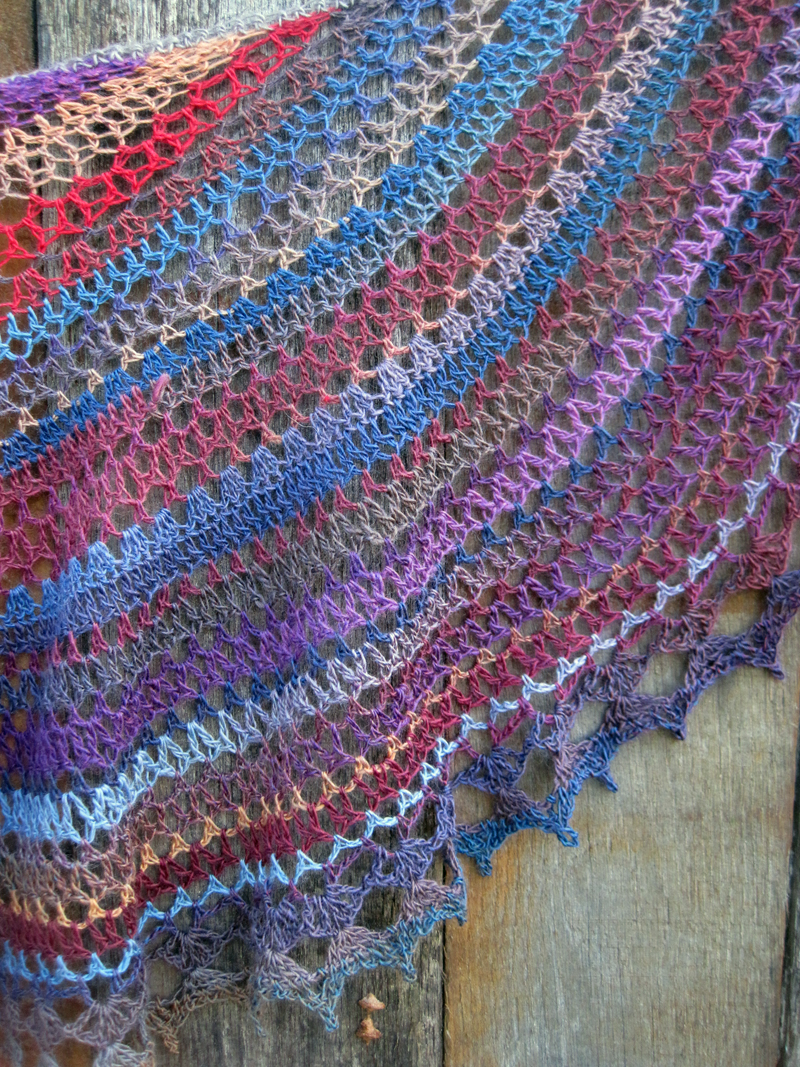
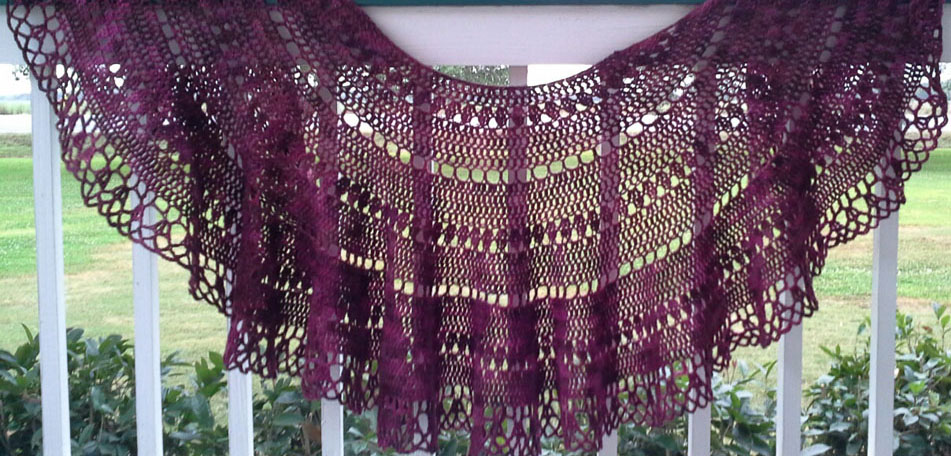
Prayer shawl Prayer shawl I made for a friend Jan. 2014

When I was working as an oncology social worker, we had a young patient with advanced colon cancer.  She was terrified of death, and also terrified of life. She was guarded with her life story, but clearly had been exposed to some very toxic faith concepts.  I spent a lot of time with her and also enlisted the help of Pastoral Care, but the twisted messages of a demanding, punishing God were seared into her brain.

I did what I could as a social worker, and I prayed.  I prayed that she would have a spiritual healing so that she could face whatever she had to in physical disease.  Perhaps she would heal physically, perhaps not, but surely God would deliver spiritual healing?

It didn’t happen that way.  Her cancer spread swiftly in spite of surgery and chemotherapy, and she died much sooner than anyone had anticipated.  I drove to the funeral home, having That Long Talk With God along the way.

“Why?” I said.  “Why?  I know she was so scared; she was afraid of You, and You could have fixed that!  In fact, You’re the ONLY one who could have comforted her, You could have at least healed her spirit so she wouldn’t have been so scared!  Why didn’t You?”

A whisper came to me, so sudden and surprising I could not have thought of it myself: I did heal her spirit.

I realized it was true.  I don’t know if it happened before her soul left this earth, or if a release from this life was the best healing left for her, but I knew in that moment that she had indeed been healed and that her spirit was truly, finally, at peace.
So what does this have to do with prayers and a blanket for a premature infant?

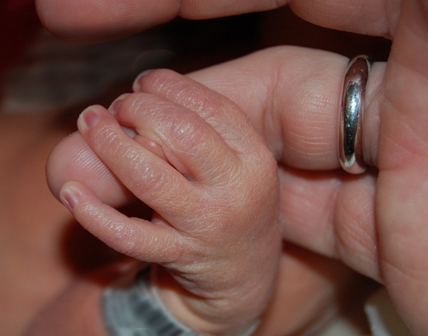
Preemie hand

I could imagine some of what Margaret was thinking. She, too, was having That Long Talk With God.  I made this blanket as an act of prayer… and it didn’t do any good. There were so many people praying for her.  And now the family has another reminder of their loss.  My prayers for V didn’t do any good. Boy, did I know the feeling.

No?  How can prayer ever NOT do good?  There is no way we can tally the effect of prayer; sometimes it seems to make a miraculous difference and sometimes it seems to vanish into nothing.  One can say “if nothing else, it helps us” but I believe there’s a lot more to it than that.  Any form of prayer opens one to Spirit.  An object made with prayer carries the intention with it. And sometimes the unexpected happens.

Margaret is a teacher, and one of her 5th grade students (Em) sat next to Margaret on the way to a field trip.  During the ride, she asked about the blanket that Margaret was working on. This opened up a conversation about the blanket, the baby, and faith. No “preaching” here, just a simple conversation and a child’s opportunity to observe faith and compassion.

Later, Em surprised Margaret with a handmade pillow with the word “Faith” on it.  Em knew that Margaret must really love the baby to make such a thing for her, and Em loves Margaret, so Em made something for Margaret that expresses that love.  She also understood that Margaret is a woman with a lot of faith. Em had lost her own mother not too long before this, yet still could express love and faith.

Margaret and I both had reactions of “my prayers didn’t do any good” and yet I know that’s not true.  A young woman with cancer moved into the surprise and joy of discovering a loving God, just in a different way from what I’d hoped for.  Margaret’s blanket touched Em in an unexpected and healing way.

And baby V’s parents have a single photo of their tiny daughter, wrapped in a blanket made with love and prayer.  We don’t always see results of prayer, and when we do, they don’t always look like we’d envisioned.  But the prayers are heard, and a prayer shawl or blanket is a tangible reminder.

Atunement

I was a smartphone holdout for a long time.  I still don’t have an iPhone.  I’ll admit a fondness for Android, probably because my Samsung screen is big and I like that little green droid guy.  There are still plenty of things that others use their phones for that I don’t, but there are some apps that I’ve found to be very handy.  One of them is Bible Gateway (www.biblegateway.com) that gives me a verse of the day, right there in my face on the screen.

Today’s verse is one I’ve always loved:

Come, let us sing for joy to the Lord; let us shout aloud to the Rock of our salvation. Let us come before him with thanksgiving and extol him with music and song.  Psalm 95:1-2 (NIV)

Of course, what vocalist wouldn’t love this verse?  Just reading this makes me think of the joy of making music and the sensation of being in tune, or atunement.

It’s a physical thing.  You’ll recognize it if you know what to listen for. Two tones perfectly in tune don’t “wobble.”  They don’t waver. The sound waves are perfectly aligned.  If you saw a graphical readout of the two waves, they would be identical.  When two tones (or melody lines) match perfectly, it’s bliss.  When they’re close, well….it’s tolerable for most.  When they’re off, it can be downright cringeworthy.  Something inside of us knows it ain’t right. (This is why I don’t watch American Idol!)

But atunement – being in tune – that’s right.  You feel it, you know it.  You feel the energy not just matched, but multiplied.

atunement

Being in tune with God is like that.  You think you’ve got it, until you really get it.  Then your realize that gee, you were a little (or maybe a lot) off.  But when you’re in tune with the Divine…it’s that feeling of being at peace, of being connected.  It’s a knowingness that you’re on the same wavelength.  (And if that sounds trite, it’s probably because it’s a really good analogy.)

That’s not always an easy place to get to, and I wonder if it’s really possible, but we can at least try.  One facet of God is that God is like a benevolent, ever-patient music teacher.  God puts up with our flat notes, sliding pitches, wobbly tones. We hear what it sounds like, and hear in our mind what it should sound like.  Most importantly, we know what we want it to sound like.

Then we have a choice.  We can either be sloppy and fake it halfway, or we can take our time and make the purest, most perfect tone that we possibly can with the instrument we have.  Making that tone of our lives the best that we can is, I think, extoling God with music and song.  It’s making a joyful noise – and we do it because we want to, because it is joyful!  Even if music isn’t your thing, you can sing (or work, or write, or play, or whatever) with joy to the Lord.  All that really matters is that you make it the best you can, and the Divine will be glorified through your gifts and your joy.

You’ll be in tune.

When in doubt…bring food.

Just a week ago I had a conversation with a couple of friends about “when in doubt, bring food.”  Whenever someone has a Major Life Event, the common response (at least in my corner of the world) is to bring a meal, a casserole, a….something edible and delicious.  I mentioned that I had often wondered if this “bring food” response is a Louisiana thing, or is more universal.  “I think it must be universal,” said I.  After all, drive-through daiquiri stands may be JUST LOUISIANA (yes, we have them) but food – well, everyone eats, right?  I was told stories by the other friends that indicated that this isn’t always the case.

Huh? This was a surprise.  If there were an official manual of Cajun Etiquette, page 1 would read simply this: When in doubt, bring food.

After all, it’s what we do.  When someone has a baby, bring food.  When someone has an operation, bring food.  When someone has a surprise, a shock, an unexpected visitor, an expected visitor (or a whole houseful of them), a new house, bring food. When you have a new neighbor, bring food.  When someone is packing to move out, bring food. And when someone dies, bring food. A meal, a covered dish, a casserole, a pot of gumbo…one brings food as a practical matter and as a symbol of sustenance.  It’s an act of nurturing, of caring and of sharing.

Bring Food

I made this for your family and mine; we don’t have to eat it together to know that we’re with you in this. We symbolically share a meal, and in a part of the world where cooking is practically a religion, the offering of a meal is sacramental: An act of grace, an expression of love. I can’t take away your burden, but I can make your life a bit easier.  I made you something that nourishes my family, I hope it nourishes and feeds your body and soul.  Have some comfort food.  Just receive; it was made with love and prayer.

If the event is a positive one, bringing food is still – always – an appropriate response.  A celebration? You’ll have company, and I know you’ll want to feed them and spend time visiting, you don’t need to be in the kitchen.  A new baby?  Rest, Mama, all y’all have to do is heat up the gumbo, and don’t forget to eat ‘cuz you have to feed that baby.  Your adult child is home from serving our country?  He or she needs some real home cooking, and you need to spend time listening, not cooking.  Eat.

Even if you are too numb to taste it, eat.  Your body needs fuel.  I thought of you and your loved ones; I prayed for you all while I chopped and cooked.  Whether prayers of supplication or prayers of thanksgiving, I thought of you as I decided what to make, selected the ingredients, and cooked.  My humble kitchen became a place of prayer as a meal for your family (and possibly mine, if the pot’s big enough) came together.

I made a lot, there’s plenty, don’t worry.  I’m not always good at saying what I feel, but I sure can cook how I feel.

Sometimes words fail us, but food doesn’t.  So when in doubt, bring food.

An Accidental Businesswoman

Melissa Bonin is a dear friend of mine, and was recently honored as an outstanding businesswoman in our community by ABiz (Acadiana Business, based in south Louisiana). I was delighted to be invited to share this moment with her, and sat with several other friends and family at the luncheon that honored her and several other standard-setting women.  Even though we recognized the many talents of our friend (“well, of COURSE she’s being honored!” was our communal reaction), Melissa was totally surprised by the honor. In her acceptance speech, she described herself as an “accidental businesswoman” because you see, Melissa is an artist.

She is also a very successful one, and over the years I’ve been amazed and inspired as I’ve watched her balance her response to the callings of her soul with the mundane tasks and trials of everyday life.  A single mother, she’s dealt with the loss of both of her parents, illnesses in her family, and the demands of allowing Spirit to speak through her eyes and hands while trusting that she had everything she needed to live, love and thrive.  Her work represents her deep relationship with the healing magic of the Louisiana landscape.  She captures living water in rivers of light; looking at her work, the viewer experiences mystery and magic – and is simultaneously graced with understanding.

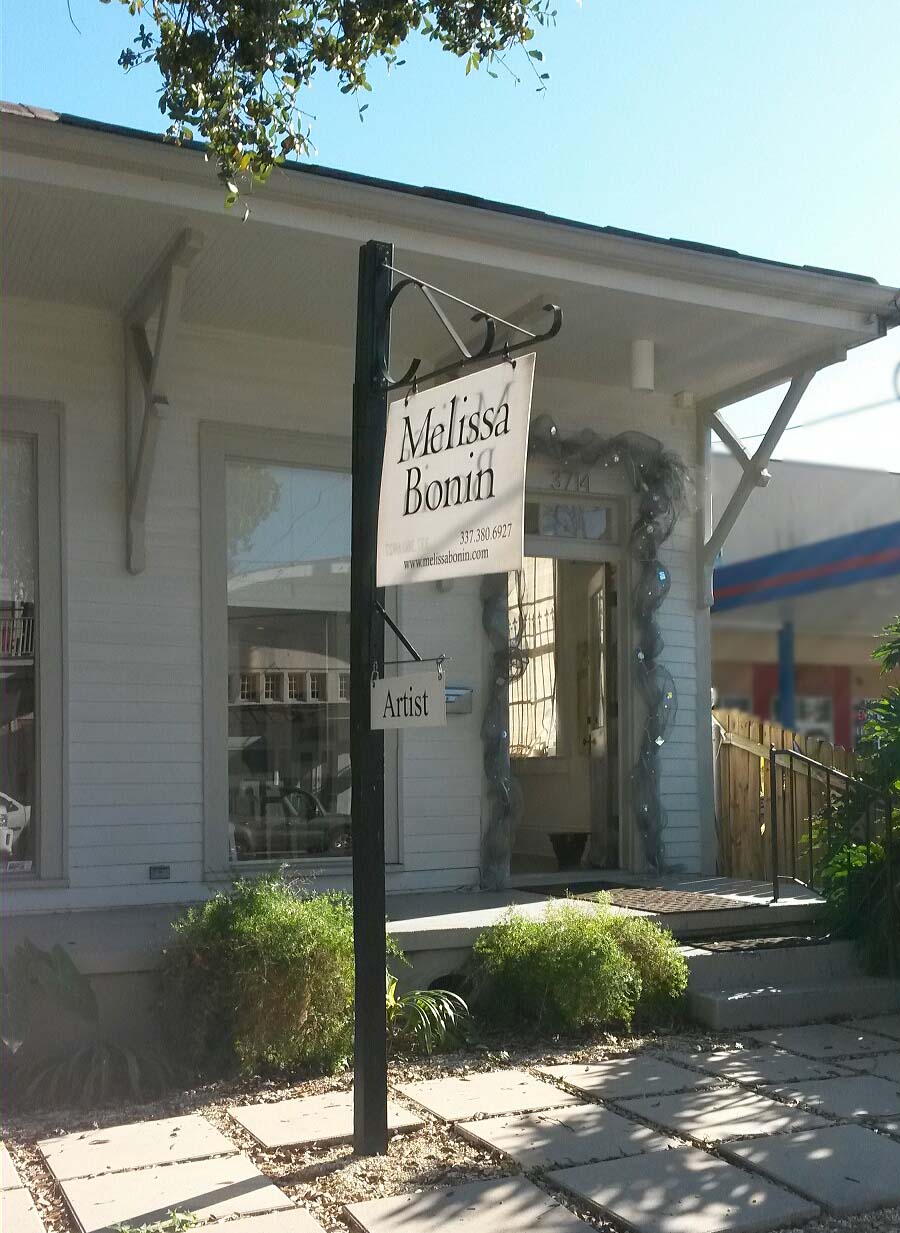
Melissa Bonin Gallery Melissa Bonin’s gallery in the Garden District, New Orleans

“To be an artist means to give voice or vision to the murmurings of the soul.  Now ladies and gentlemen, you try to put that into a business plan,” she told the crowd gathered that day.

A business plan, indeed.  She doesn’t need to swim in the “shark tank” to chart her path or grow her business; she listens to her heart and follows the call of the soul – and she paints. She says “…if I valued  my soul’s voice and made my choices based on this belief …… all good things I wished and dreamed would happen.”  What has guided her are the questions: “ Does this honor the work? What does the work require next? Does this bring joy? Does this affirm life? Does this inspire?”

I listened to her acceptance speech that day with tears in my eyes.  In her usual uncanny way, she had summarized the challenges that so many of us face, and charted a path for meeting those challenges.  As I listened, I simply said “well, of course.  Put the call of the Soul first, and things will fall into place.”  I’ve sometimes thought this to be impossible, but Melissa exemplifies this.  She puts the most precious things first – her son, her art, the life of Spirit and Soul.  It’s not an either/or, they all fall into place, with everything else second.  Like so many other women, she’s found that it can be a bit of a high-wire act with bated breath and occasional heart-wrenching slips….but things come together and balance is achieved.

I’ve carried her words with me since that day, and have found inspiration for clarity, especially when I am overwhelmed.  Asking myself “ Does this bring joy?  Does this affirm life? Does this inspire? Does this draw me closer to Spirit?” If the answer is yes, then I can move forward, even if I am fearful.

Enjoy the life-affirming and inspirational work of my friend, gifted artist Melissa Bonin, at www.melissabonin.com and in person at her gallery at 3714 Magazine Street, New Orleans, LA.

Prayer Shawls * 3 Dimensional Prayer

Thoughts at the beginning of a Shawl Ministry at the Episcopal Church of the Epiphany in New Iberia, La.

“Shawls … made for centuries universal and embracing, symbolic of an inclusive, unconditionally loving, God. They wrap, enfold, comfort, cover, give solace, mother, hug, shelter and beautify. Those who have received these shawls have been uplifted and affirmed, as if given wings to  fly above their troubles…”

                                  Written in 1998 by: Janet Severi Bristow    From the home page at:  http://www.shawlministry.com

prayershawl1

Wrapped in Prayer

I had a Zen teacher in college, Fr. Benjamin Wren, SJ, who taught – among other things – liturgical dance, ikebana and Tai Chi.  He called these “3 dimensional prayer.”  I thought of Fr. Wren when I started exploring the interest level for a shawl ministry at our church, because I also think of prayer shawls as “3 dimensional prayer.”

Shawls are practical, beautiful, nurturing.  Even though the idea of a prayer shawl ministry didn’t really burst into modern consciousness until 1998, shawls have been present in spiritual practice for a long time.  I think of the Jewish Talit, or fringed prayer shawl, worn at various times by Orthodox, Conservative and Reform Jews.  Our priests, deacons and bishops wear stoles when leading a service. Mantillas may still be worn by Spanish Roman Catholic women for worship (and were extremely common in French/Spanish south Louisiana in pre-Vatican II days). Pentecostal Churches may have “prayer cloths” – cloths that have been prayed over and in some cases, anointed.  All of these practices may serve to set the wearer apart, or to help the wearer indicate, even if only to oneself, that this time is now for prayer.

I can appreciate the concept of a prayer cloth.  Here’s something tangible that has been prayed over, given to someone to hold, to touch, a tactile reminder that someone else has been praying for them.  It’s a powerful thing to know that someone is praying for you, and having something in hand that underscores that can serve as a strong reminder: You are loved.  You are remembered and cared for by this community.  You are a child of God, our sister or brother in Christ, and this is a symbol of our ongoing prayer.

A shawl is this symbol, that wraps one in a comforting embrace.  So where did our 21st century concept of a prayer shawl ministry come from?

MonicaShawl

Monica’s Prayer Shawl

Do an online search for “prayer shawl ministry” and you will learn of two women who had attended and graduated from a Leadership Institude in Hartford, Connecticut in 1998.  They’d been in a program of applied Feminist Spirituality with Professor Miriam Therese Winter.  Professor Winter is a Roman Catholic nun (Medical Mission Sister) and an author and songwriter whose works are well worth exploring. These women, Janet Severi Bristow and Victoria Galo, combined compassion, prayer, and a love of fiber arts into a prayer ministry and spiritual practice. Their journey and ministry is described on the website, www.shawlministry.com.

Since then, prayer shawl patterns have been becoming more and more common.  Sure, it’s marketing, but I’m very glad to see this concept blossom in spite of the “secularization of America.”  Yarn manufacturers are designing simple patterns and actually calling them prayer shawl patterns.  Lion Brand Yarn(www.lionbrand.com) has a great assortment of knitted and crocheted prayer shawls.  Several books are available for crochet and knitted prayer shawls, and a “prayer shawl” search on the fiber lovers’ website www.ravelry.com yields (as of this writing) over 20,000 member projects tagged with the term “prayer shawl” or “prayershawl.”

What makes a prayer shawl a prayer shawl?  Intention.  Compassion.  Blessings, and of course, prayer.
The shawlmaker only needs basic crochet or knitting skills to do the work.  A shawl is begun with intention, with prayer and blessings for the recipient, and the shawlmaker may or may not know the recipient.  Shawls may be made with the intention that they will find the person who needs it most.  In other words, the Holy Spirit does the heavy lifting.  When the shawl is completed, the group (and anyone else who wants to join their prayers) may say a prayer for the recipient before sending it on its way.

Prayer shawls may be made for anyone – woman, man, girl or boy and they may be adapted according to the comfort of the recipient – a “prayer square” with a Cross (or Magen David) motif, or a small blanket  may be more appropriate for some than a shawl.  They may be made for someone going through medical treatment, for someone experiencing a loss, bereavement; a life-changing event (which can be joyous as well!), ordination…whatever!  A small cross or charm may be attached to the shawl, this is entirely optional.  Most ministries include a prayer with the shawl – and care instructions help, too!

No matter where you are with your craft, making a prayer shawl is a beautiful thing.  Your stitches don’t have to be perfect, just made with compassion and intention.  Remember that when you make a shawl (or blanket), you are, in a sense, joining the recipient on their journey one stitch at a time, one step at a time, one prayer at a time.

High Holy Days

I sing at our local Jewish temple, which is Temple Gates of Prayer in New Iberia, Louisiana.  This is a small congregation, deep in the primarily Christian area of south Louisiana.  The temple, over a hundred years old, is within walking distance of churches that are Roman Catholic, Baptist, Methodist, Episcopal, Church of Christ and Methodist Episcopal, with other denominations in the area (just not within walking distance).  I have sung there for over 10 years, and feel very blessed to do so.

Temple Gates of Prayer New Iberia Louisiana Temple Gates of Prayer, New Iberia, LA

When people learn this, they want to know how this Christian musician wound up singing at a Jewish church.  Just lucky, I say. I was in the right place at the right time when their previous vocalist retired, and I was willing (and excited) to tackle something new.

And so it was that I encountered a whole new world of music and of worship.  I learned the Sh’ma and the Bar’chu. I learned that while vowels weren’t exactly an afterthought in Hebrew,  they probably weren’t on the tablets that God gave Moses.  I also learned that different rabbis write transliterations (phonetic spellings) of the same word in many different ways!

I write this in the middle of High Holy Days, which encompass Rosh Hashana (the new year), Yom Kippur (Day of Attonement) and Shabbat Shuvah, which is the Shabbat that falls in between Rosh Hashana and Yom Kippur.  For Gates of Prayer, this time also marks the arrival of their new student rabbi.  As a small congregation, they are served by rabbinical students.  This year is extremely unusual as they have the same student as last year, Alex Kress.  (Most of the time there is a new student rabbi every year.)

This personnel change is unusual; most churchgoers, regardless of denomination, are used to having a spiritual leader for longer than 9 months at a time.  The rabbis may change, but the congregation must stand on its own as a community. They do so, and embrace each new rabbi with open arms and open hearts.  (This being south Louisiana, I must add “open kitchens” as well!) The rabbis become a part of the community, and I think they leave a part of themselves here.

Over the years, I’ve been asked questions members of my “Jewish church family” and my “regular church family” (and other curious souls).  I’ve often heard comments / questions about my level of participation in the service at Gates of Prayer.

“You read along with the prayers?” Yes, of course.  Prayers all go to God, regardless of where I’m standing when I pray.  The prayerbook I use doesn’t matter.  Prayer comes from the heart.

Perhaps the biggest lesson of the many I’ve learned from my years with Congregation Gates of Prayer is simply this: There is much more that draws us together than that which separates us.  We pray for peace, for compassion, for redemption and forgiveness. We pray for those we love, and we pray for help in loving those who may be hard to love.  We pray that we may be better people..  Being Christlike is doing (following) mitzvah.  Love God, do good, follow the commandments.

It’s all good.  It’s all God.

Beyond Piano Lessons

“Mama, I want to learn piano. Mama, can I take piano lessons? Mama….Mama….” I don’t remember where this obsession came from.  I just remember my childish frustration with my toy piano with painted-on black keys.  I had no access to a “real” piano, but I KNEW those painted-on keys did NOT SOUND RIGHT.

Then, too, was also the frustration of how to play songs.  I could pick things out by ear, but there had to be other ways, to put music together like I’d seen on TV.  I had been so excited to start school and adored reading, but by the second grade I had seen this other mysterious printed language that promised something even more wonderful than a story: Music!  I knew that if I could read words, I could learn to read music, I just needed someone to teach me.

One day, Mom saw something in the paper about piano lessons.  “Mrs. Clark!” she exclaimed, “why, she taught me Geometry in high school!” A phone call was made, and not long afterwards we were heading to town where I was introduced to a lovely older lady with tight grey curls, orthopedic shoes, thick bifocal cat-eye glasses and a twinkle in her eyes.  Her home was small and simple and smelled of pine, furniture oil, Cashmere Bouquet and baked goodies that I couldn’t quite identify.  Best of all, there, was an upright piano in a place of honor, right in the front room.

Mom sat with us during my first lesson.  At the end of that lesson, we all agreed that we would continue.  I went home with Eric Steiner’s Junior Approach to the Piano, and headed to my aunt’s house to practice, as she had a piano.  Within a week or two, a rental piano was delivered to our home, and Mom was bringing me twice a week to Mrs. Clark’s house.

I suppose other teachers could have guided me through learning to play, but Mrs. Clark taught me more than that.  She never hosted recitals (saying she was too old), but focused on a student learning to play whatever music they loved.  To be sure, we worked through entire courses from Eric Steiner, John Thompson, and Michael Aaron (along with Czerny’s School of Velocity and quite a few theory books), but she also welcomed anything I happened upon that I brought in to tackle.  From the Reader’s Digest Fireside Book of Folk Songs to books of popular songs and various “Greatest Hits of……” it was welcomed in Mrs. Clark’s home.

I didn’t just learn to read music and play piano.  I also learned to make graham cracker brownies (she always had a bag of these for me, and for every student after each lesson) and I loved hearing her stories of playing for the silent movies when she was a teen.  She was born in the late 1800s, and I began taking lessons from her in the late 1960s, so you do the math.  She had fallen in love with a man considerably older than she was.  They had fewer years together than many couples, but those years were precious and filled with joy.  They had one son. She saw both World Wars, and told me what it was like “back home” during those difficult years.  She listened to my joys and frustrations at school and dispensed advice without my even realizing it.  Over the years, she became more housebound, but her students brought her joy and, she said, “kept her young.”  She wasn’t able to attend church often, but would get dressed up to watch Sunday services on television.  She would also make it a point to watch every Alabama football game that was televised; Coach “Bear” Bryant had been a student of hers some years before, so needless to say, she was a huge fan of the Crimson Tide.

I learned from Mrs. Clark that making music is more than just playing in perfect time with a metronome; it’s about playing with joy.  If you miss a note, she’d say, just keep going and carry an attitude that said everything was perfect.  I didn’t realize it at the time, but playing piano for a silent movie demanded that, just as does any situation of performing live for an audience.

When I was halfway through high school, she announced that she would be retiring from teaching piano and moving away to be closer to her only son.  Before leaving, she gave me a stack of her sheet music from the early 1900s.

mrs clark music upload

I couldn’t imagine having any other piano teacher; what could they possibly teach me that Mrs. Clark had not already taught?  I could practice on my own, and did so.  I poured my focus into other high school activities and trying to figure out what to do with my life. We kept up through letters, and I was able to visit her in her new home (about an hour away) on a couple of occasions.

She moved into a nursing home when I was in college, but we would still correspond.  I was busy with classes, and she and my mom corresponded as well.  Her mind was sharp as ever, and she asked the nursing home staff what she could do to assist with recordkeeping, letter writing, etc.  Health care privacy laws were not quite as strict then as they are now, and she was a welcome help to the staff. Her one complaint?  “All these old people around here who complain all the time!”

She died not long after I had graduated from college.  I went to the funeral home early in the morning on the day of her funeral, and sat quietly in the parlor and gave thanks for the incredible gift that she was in my life.  Even today, 3 decades later, I think of her and give thanks for her presence in her life.  I didn’t realize then that her teachings were applicable to life:  Do things you love with joy. If you mess up, just keep going with the attitude that everything is fine, because it really is.

In memory of Mrs. Edna Reynaud Clark, 1891 – 1984