July 22 has long been recognized a feast day for Mary Magdalene in the Episcopal Church and as a commemoration in the Roman Catholic church. This year, Pope Francis officially promoted July 22 to a feast day for Mary Magdalene.
There is so much to be said about her, and so much more that we don’t know. Today I’ll write a bit about the gospel that bears her name. This gospel was unknown and forgotten for about 15 centuries, and even today, we have only about half of it.

A fragment of the Gospel of Mary
I’ve wondered not only what was in those missing pages, but also why they are missing.
You may have never heard of the Gospel of Mary Magdalene, as it only hit mass publication within the past 20 years or so. Here’s a (very) abbreviated introduction: There are quite a few non-canonical writings dating from the early Christian era, as you probably already know. Some were found among what is commonly referred to as the “Dead Sea Scrolls,” and others have come to light in different ways. This particular codex, written in Coptic, surfaced in the late 1800s via an antiquities dealer who didn’t have much information about its background. (“oh, it was found…er, in a niche of a wall….by um, a peasant…oh, out in um…Egypt.”)
Which might sound a bit shady, but such stories aren’t uncommon. The section of this gospel was part of an otherwise complete codex from the 5th century. The (incomplete) Gospel of Mary was but a small part of this book, which also contained the Apocryphon of John, the Sophia of Jesus Christ, and the Act of Peter. This book, incidentally, was in excellent condition – which lead at least one expert to question the “found in a wall niche” narrative. (The image above is from a later find of a smaller fragment.) The only thing wrong was that the first 6 pages and 4 other pages from the middle that are missing – from The Gospel of Mary. According to historian and author Karen King in The Gospel of Mary of Magdala, “It took…some time to realize that the book was nearly intact and must therefore have been found uninjured.”
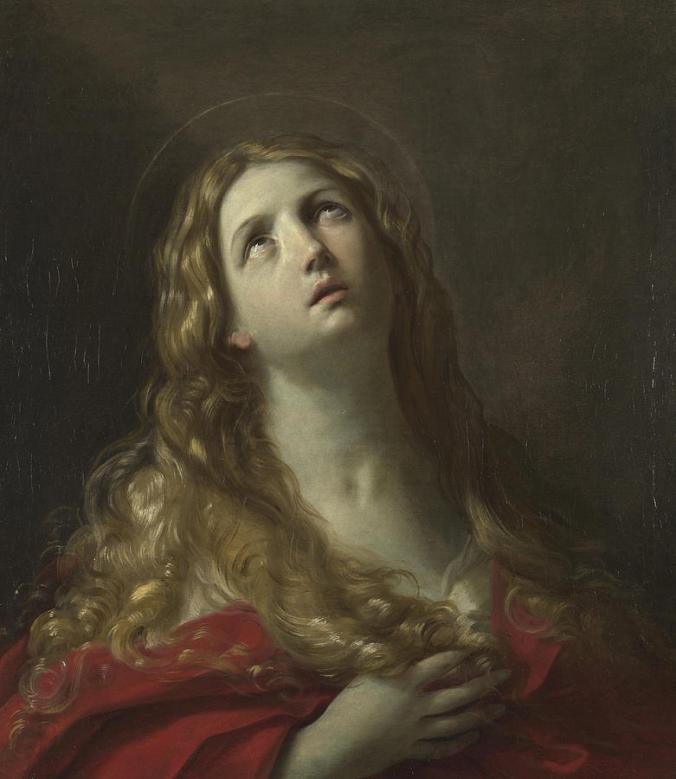
Mary Magdalene by Guido Reni
Over time, two additional fragments were found, fragments that held parts of the same passages. In 1917, a Greek fragment was found in Northern Egypt. It dates to the early 3rd century CE. Another Greek fragment of approximately the same age and severely damaged, was also found. Different languages and dates indicate that this is a book that had been copied, so its influence was somewhat widespread. Also in the mid 20th century, there was a discovery of manuscripts near Nag Hammadi in Egypt, and there were copies of the other texts found with the Gospel of Mary – but no other Gospel of Mary.
At the present time, only these 3 partial copies are known to exist. (Another possible fragment has surfaced, and to my knowledge, its authenticity is still not certain.) King states “Because it is unusual for several copies from such early dates to have survived, the attestation of the Gospel of Mary as an early Christian work is unusually strong. Most early Christian literature that we know about has survived because the texts were copied and then recopied as the materials on which they were written wore out.”

Mary Magdalene by Dolci Carlo
Today, we may think that the only early Christian texts were those of the New Testament, the Apocrypha, and a few “heretical” gnostic texts found in the middle of a dessert. (The process of how the books that made it into the New Testament is a whole ‘nuther subject…) Well…there were likely more than that. Christianity – the Gospel, the “good news” – was spread by word of mouth first. The early Christians had no bible, no catechism, no Sunday school, no confirmation classes, no chain-of-command, no church hierarchy, not even a creed to guide them. Rather, they had Jesus’ disciples sharing the wonder of their experience of the risen Christ (which sounds more interesting than the creed), and met in homes. Over time, the Jesus movement spread beyond the Jews to the Gentiles and to other lands…and interpretation doesn’t take place in a cultural vacuum.
Hence, all these gospels and writings were views of Jesus by different groups. Instead of being fearful of anything “unorthodox,” why not dive into such writings with curiosity? We have a chance to look at Jesus through different eyes, through the eyes of those much closer to the historic event of the risen Christ. I don’t know about you, but I find that fascinating! (And then, there was the big question of who wrote it down!)
I wonder what happened with the Gospel of Mary. The section that exists tells of a scene that takes place after the resurrection, and in it Mary Magdalene is sharing (at Peter’s request) teachings from Jesus that are unknown to the apostles. They aren’t too happy about that, by the way. Some of these teachings sound familiar, but some don’t. Mary comforts the disciples, and begins teaching, sharing what Jesus has shared with her. Her role as “apostle to the apostles” now includes “teacher of the apostles” through the authority of Jesus.
As such, it underscores the legitimacy of women’s leadership in the early church. While the books that would become the canon were slowly “rising to the top of the heap,” others were fading into obscurity. No one was copying them any more. At the same time, certain strains of Christianity were fighting it out, so to speak, and a hierarchy was beginning to emerge. Can you say power struggle?
I suppose the final blow to Mary Magdalene’s status as a teacher and possibly a church leader came when Pope Gregory I started that nasty prostitute business with a sermon preached in 591 in which he described the 7 demons (that Jesus had cast out of her) as the 7 deadly sins. The fact that some folks kept getting her mixed up with the “sinful woman with the alabaster jar” didn’t help. The rest, as they say, is history; resulting in a case of stolen identity that not even Lifelock could fix. For centuries, she has been portrayed as the repentant prostitute rather than a loyal disciple, apostle and teacher.
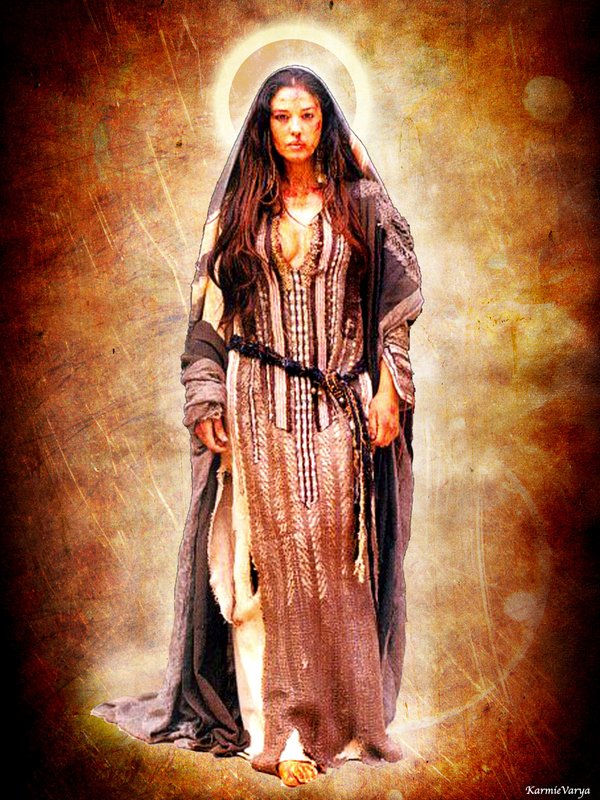
A woman with a mission! from Karmievarya on DeviantArt.com.
Although the Roman church officially abandoned the prostitute idea in 1969, the damage was deep and long-lasting. Even today, the image of her as a repentant sexual sinner lingers on. (Just ask Hollywood!)
This isn’t the place for a full discussion of the Gospel of Mary – the work itself is small, and you can find it online (along with plenty of discussion about it). Karen L. King’s book The Gospel of Mary of Magdala: Jesus and the first woman apostle is not just a translation, it places the book in historic context and discusses the contents. There are countless other books and online resources on Mary Magdalene as well. I can think of no better way to honor this great early Church Mother and Saint by taking some time on her feast day (July 22) to learn more about her, and to let her love for and commitment to Christ inspire our own discipleship.

 a samaritan woman