Martha’s Blues

“Are you a Martha, or a Mary?”

How many times have I heard this question asked? I’ve no doubt said it a few times myself. I recently read an insightful commentary (on Instagram, go figure) that touched on the heart of the matter in Luke 10, when Jesus visits the home of his friends Martha, Mary and Lazarus. Martha is busy serving, and Mary is sitting down, listening to Jesus.

I will readily admit to being Martha. After all, somebody has gotta get this s**t done.

The point made was that it wasn’t a situation of Mary = good, Martha = bad. Martha was in her expected role, and provided a great service with her hospitality. She fed Jesus and his followers and made them comfortable and welcome. She provided a safe and welcoming place for the ministry; a refuge from the world where disciples could sit and listen attentively.

The problem was that Martha was anxious, distracted, and focused on something other than Jesus’ message. She was serving, but not with an open heart and open ears. Even something as inspiring and awe filled as Jesus sitting in her home and teaching became something stressful.

Martha did what had to be done, and what WAS the right thing to do. But Jesus did point out, very gently, that spiritual discernment is a “better portion.” There’s a saying “let go and let God,” which reminds us that we DON’T have to try so hard. Maybe we can keep doing what we need to do, but focus our minds more on Spirit than on matter.

Because s**t still gotta get done.

Christ at the home of Mary, Martha, and Lazarus Jacopo Bassano c.1577, Museum of Fine Arts, Houston TX

I joke that my title at work is She Who Does That Which No One Else Will Touch. Computer headaches, dealing with AT&T (and other assorted technology), tracking down clients who are slow in paying, insurance, HR, figuring out assorted regulatory compliance, you name it.

It’s a far cry from the career path I’d started on a few decades ago: Licensed Clinical Social Worker. I keep my license current and do “a few things,” but life interfered and I found myself in the family business because hey – family needed me.

I’ll be honest – there are days when I throw up my hands and say “WHAT am I doing?” There are days when I just want to run away from the world of management and regulations and go back to being a Social Worker. Please don’t make me deal with nonfunctional technology; can I just go back to dealing with serious mental disorders and a few garden variety neuroses instead?

I often wonder if I’m making a difference or helping anyone in this role, and I start to feel like Martha. Frustrated, overworked, unseen, not enough help and not really able to help. Why did I sign on for this?

Well…because of love. Like Martha, I sometimes need a nudge in the “discernment” department. I do this because I love my family. I love what my parents built, and what we continue. I care about our employees, and I care that we have built a good, supportive place to work. I love those days when I look around and think “wow, we really have some good people here.” We are blessed.

I wasn’t familiar with the website that posted that commentary on Instagram; http://www.qava.tv . A quick online check tells me they are a Christian streaming service, offering a wide variety of programs. Thanks, Qava folks, for this thought provoking commentary. It hit me when I needed a reminder that we all need a balance of Martha’s action and Mary’s attentiveness.

Some years ago I wrote a song called Martha’s Blues, focusing on…well, you can probably figure out what it’s about. Pity poor Martha, she’s got the blues; housework fights forever and you’re always gonna lose. It’s a part of the Women at the Well program, and the last time I performed it was at an event honoring the memory of my late music partner Joshua “Bubba” Murrell. It’s always been one of my favorites from that program, and you can listen to it here. Since Covid, we hadn’t been able to do many Women at the Well programs, and I miss that. I wonder sometimes what it would be like to present the program on my own? I wonder what Martha and Mary would advise?

Holy Week

Holy Week is nearly done, but I can’t let it go by without sharing this thought: Humanity really doesn’t change.

It doesn’t. In spite of technological, scientific, medical and other advances, people remain…people. Holy Week slaps us in the face with that fact.

Yesterday’s Darling is today’s Outcast. Jesus rode into Jerusalem in triumph, to adoring crowds. He was (and remains) the Ultimate Influencer. One week after receiving a hero’s welcome in Jerusalem, he was crucified. Really, have times changed? He was the ultimate badass that the crowd loved, turning over tables and talking trash to The Powers That Be. The crowds couldn’t get enough of him. A week later, he’d been deplatformed in the worst possible way.

Today, we can consider any number of popular figures, politicians, leaders, entertainers, commentators, etc. etc. etc. and (whether you love or hate ’em) you’ll see how swiftly the tide can turn. This should clue us that human opinions have absolutely nothing to do with facts. (Pilate said to him, ‘what is truth?’ – John 18:38 or paraphrased in Jesus Christ Superstar by Pilate: “What is truth? Is mine the same as yours?” a profound question, and one that has stayed with me for decades.) The details change, but human nature hasn’t.

And really…what is truth? Why are we so quick to proclaim someone a Savior or Messiah – and then turn on them when WE don’t think they deliver like we think they should? It’s a paradox: We think we need someone/something greater than ourselves to drag our sorry rears out of the muck…but then, we reject that someone because they’re not what we expect or think we want. We get nasty and really, really ugly.

Fortunately, there is a Love that will save us from ourselves, in spite of ourselves. Being human is a privilege, a gift, even though it is a tangled, messy, crazy, emotional journey. Never forget that Love came down at Christmas, or the incredible example of love on Good Friday. Jesus joins us on that human journey, and reminds us that in spite of our human craziness, we are worthy of love. And we are loved.

God-Stuff

We are powerfully creative.

And why shouldn’t we be? We are made of God-stuff.

In the beginning, was the Word. Our Creator spoke everything into being and began the cycles of life and creation that would bring forth each atom, each spec of being, each human soul.

What, exactly, are we made of? Whatever term you want to use for the Divine Creative Mind – God – had only Divine Self. Everything is made of God-stuff, and we are made in the image of that Creator.

We can be active co-creators of life and of our pocket of reality. We always are, whether we want to be or not. I hate hearing the media calling anyone “victims,” for it implies powerlessness.

While some circumstances are certainly beyond our control (sometimes feces occurs), our reaction to circumstances isn’t. Terrible circumstances can take time to overcome, and some cannot be overcome in this world.

Yet – we can decide how to face circumstances.

I remember when I worked as a Clinical Social Worker on the oncology floor of a hospital. I was asked to see a woman who had recently been diagnosed with cancer, and was refusing chemotherapy. My mission was not to “try to change her mind.” Rather, it was to provide another set of ears. Her oncologist and nurses had already discussed the clinical aspects of her decision. I was there to discuss the psychosocial aspects of her decision. Years later, I remember her resolve – and her peace.

She didn’t have an attitude of “poor me.” Rather, she was peaceful, and felt that her quality of life was of primary importance to her and her family. She was also a woman of faith, and knew that life continued beyond the physical.

Her choice wasn’t to lie down and die; it was to live fully for as long as she could. Contrary to what some might say, she didn’t just let life wash over her. She knew that sooner or later, things would get better, and reminded herself of it constantly.

When we were faced with something painful, mom would remind us that “this, too, shall pass.” I remind myself that “things are getting better” because eventually – they do, even though our brains may scream in revolt at times. Working on this mindset also puts us in a mindset of gratitude.

Magically, things eventually do turn around. We recognize the blessings that we do have, focus more on them, and find other things for which to be grateful. Things get better.

Why? Because you, dear reader, are infinitely creative, and made of the same stuff that God is made of.

Image: Solar eclipse, August, 2017 © B. D. Lowry

Merry Christmas!

Merry Christmas? But…it’s January 4!

Yep! And we’re still in the Christmas season. Epiphany isn’t until Monday, and my decorations are still up. It won’t take long to take them down, as I’ve simplified things over the years, but they probably won’t go back into the boxes until next weekend.

It was a nice Christmas, all things considered. The last few years were pretty lousy – three years ago, pop died. Two years ago, I broke my ankle and spent Christmas recovering from surgery (I won’t say it was “shattered” as my very talented orthopedic surgeon managed to find all the pieces of bone and reassemble them with some heavy-duty hardware), and last year my best friend and music partner died suddenly right before Christmas. This year, we lost mom – which should have made it another crappy Christmas.

But oddly – it wasn’t. Maybe it was because we all breathed a collective sigh of relief that she and pop were together again. Maybe it was because she wasn’t suffering any more. Maybe it was because we all realized that, as hard as it was, it could have been a lot worse.

And maybe – just maybe – this Christmas was a gift from the Holy Spirit.

Sure, we got a little weepy. We missed some people terribly. Mom had left some instructions for some personal gifts, which were given out. I’d like to think that mom was able to see everyone’s reactions. I do know I felt her presence – and pop’s, and Bubba’s – very strongly. Does it take the place of their being there “in the flesh?” Of course not. But because of Christmas – and Easter – we know we will be with them again. We know they are wrapped in love and peace.

And of course, there were some laughs: My brother continued the tradition of the rubber chickens. Once again, his ceiling (and it’s a tall one) is covered with little rubber chickens. It started a few years ago when he ordered a pack of small rubber chickens (you shoot them like rubber bands) from “slamazon” (as my friend Cathy J calls that big online retailer), intending for us to shoot them at one another like the overgrown kids we all are.

I’m pretty sure it was Bubba who first aimed a chicken at the ceiling. Or maybe Harris. Hey! They stick! And so a new holiday tradition was born.

Can you hear it? “Oh, we love to decorate the tree as a family on Christmas eve after we go to church, and then after Christmas dinner we go caroling! What do you do, Brenda?” “Oh, we crank up the air conditioning, build a fire in the fireplace, drink champagne and shoot rubber chickens at each other and at the ceiling.” Yep, that’s my family.

And among all of this craziness is family, love, and the peace of the Holy Spirit. I realize a lot of people struggle with Christmas. I have for years – so did mom; she said that she was reminded of all those she loved who had left this life. I do think she had a better Christmas this year, as did pop, Bubba, and all of our loved ones on the other side. #84 in the Hymnal 1982 sums it up beautifully:

May the peace of the Holy Spirit and the gift of the Incarnation be with you throughout the year. And don’t be afraid to say it: Merry Christmas!

It Is Well With My Soul

Today is Mary’s 85th birthday. I’ve had the joy of knowing her – and singing alongside her – for about three decades now. Her birthday falls ON “Birthday Sunday,” the first Sunday of the month where we pray (and sing!) for those in the congregation celebrating birthdays in the coming month.

Leon chose an anthem arrangement of It Is Well With My Soul for us to sing, as it’s a favorite of Mary’s (the rest of the choir loves it too). She sang a beautiful solo on the first verse, and it was all I could do to come in singing when the rest of us joined in because it was so moving.

It is a hymn that bears special meaning, and when you know the story behind it, you can really understand why this song touches the spirit so deeply.

Horatio Spafford and his wife had already lost much – the death of a son, followed closely by the great Chicago fire and destruction of his business – all in the same year, 1871. Two years later, Spafford was planning a trip to Europe for himself and his family. A last minute problem with his business delayed him, but he sent his wife and children on ahead with plans to take another ship and meet with them in a few days.

The ship carrying his wife and four daughters was struck by another ship and went down. His wife survived, but his daughters did not. Spafford immediately went to join his wife, and it is said that he wrote It Is Well in the area where the ship carrying his family went down.

The melody, written by Phillip Bliss, is called Ville du Havre – after the name of the ship that went down.

After the tragedy, the Spaffords had three more children, with one dying of scarlet fever. They eventually moved to the Holy Land and led lives devoted to service.

Their story is incredible, as is their faith. It’s hard to imagine having such soul-ripping events – and still be able to say it is well with my soul. I don’t doubt that the Spaffords had moments of deep anguish and despair. But the words strike right at the core of what is most essential, and beautifully so:

When peace like a river, attendeth my way,
When sorrows like sea billows roll;
Whatever my lot, Thou hast taught me to know
It is well, it is well, with my soul.

It is well, (it is well),
With my soul, (with my soul)
It is well, it is well, with my soul.

(And the final verse:)

O Lord, haste the day when my faith shall be sight,
the clouds be rolled back as a scroll;
the trump shall resound and the Lord shall descend;
even so, it is well with my soul.

Source: https://hymnary.org/text/when_peace_like_a_river_attendeth_my_way

You may also find the hymn listed as When Peace Like a River.

Peace can be like a river – sometimes quiet, sometimes turbulent and nonexistent. But whatever my lot, there is refuge in God’s promise. This line that doesn’t appear in every hymnal:

No pang shall be mine, for in death as in life,
Thou wilt whisper Thy peace to my soul.

Sometimes that’s all it is, and all it takes; just hearing that whisper. We can cling to it as we would a raft in a turbulent river and hold on, knowing that somewhere at the end of that rope is peace, even if we can’t quite grab it yet. This is the promise of God, the promise of Christ, the promise of Love.

Happy birthday, Mary. And thank you for giving us a gift with your voice; a beautiful and heartfelt reminder that while hearts may be breaking and we may feel we’ve given up, it is still well with my soul.

Good Friday

For God so loved the world, that he gave his only Son, that whoever believes in him should not perish but have eternal life. For God did not send his Son into the world to condemn the world, but in order that the world might be saved through him. Whoever believes in him is not condemned, but whoever does not believe is condemned already, because he has not believed in the name of the only Son of God. And this is the judgment: the light has come into the world, and people loved the darkness rather than the light because their works were evil. For everyone who does wicked things hates the light and does not come to the light, lest his works should be exposed. But whoever does what is true comes to the light, so that it may be clearly seen that his works have been carried out in God. John 3:16-21

The good news of Christianity is that we are forgiven through the sacrifice of Christ; Jesus suffered and died for our sins and rose from the dead.

This is wonderful news!

But…I’ve always had a teeny, tiny problem with this. If God loves us so much, why did God demand a sacrifice to forgive us? That just seems a bit…conditional.

Forgive me if my sick sense of humor wanders into the realm of the near-ridiculous as I can’t help but imagine a hypothetical (and somewhat Monty Python-esque) conversation….

God the Father: Sheesh. LOOK at them, will you? I’ve given them commandments, guidance, a burning bush, manna from heaven, and STILL they screw up. I’m done with humans; they’re all fit for nothing but the burning pit of hell!

God the Son: Oh, come on, they’re not THAT bad. Give them a chance. Maybe eventually they will figure it out.

God the Father: Hm. I don’t know…but maybe I could be persuaded IF they made a big enough sacrifice. But it would have to be big – I’m really not happy about them.

God the Son: I don’t think they are capable of appeasing you. Tell you what – how about I do it for them?

God the Father: Hmmm. Well, let’s see. How about you become one of them? Like, become human.

God the Son: I can do that.

God the Father: And…not in a life where you’d be a crown prince or anything. I know! How about you become…hmmm, how about a carpenter?

God the Son: OK, I’ve always wanted to make things out of wood.

God the Father: You can teach them what they really need to know: How to treat and love one another. I gave them commandments, but they still mess it up. Oh, and throw in some miracles and healings so that they pay attention.

God the Son: I can definitely do that. Hey, how about turning water into wine? That sounds like a good start.

God the Father: But, in order for me to forgive them and bring them home to me, you need to die a horrible, dreadful, painful, excruciating death.

God the Son: Um. Ahhhh, you sure about that? Well. OK, if you insist.

[end of conversation]

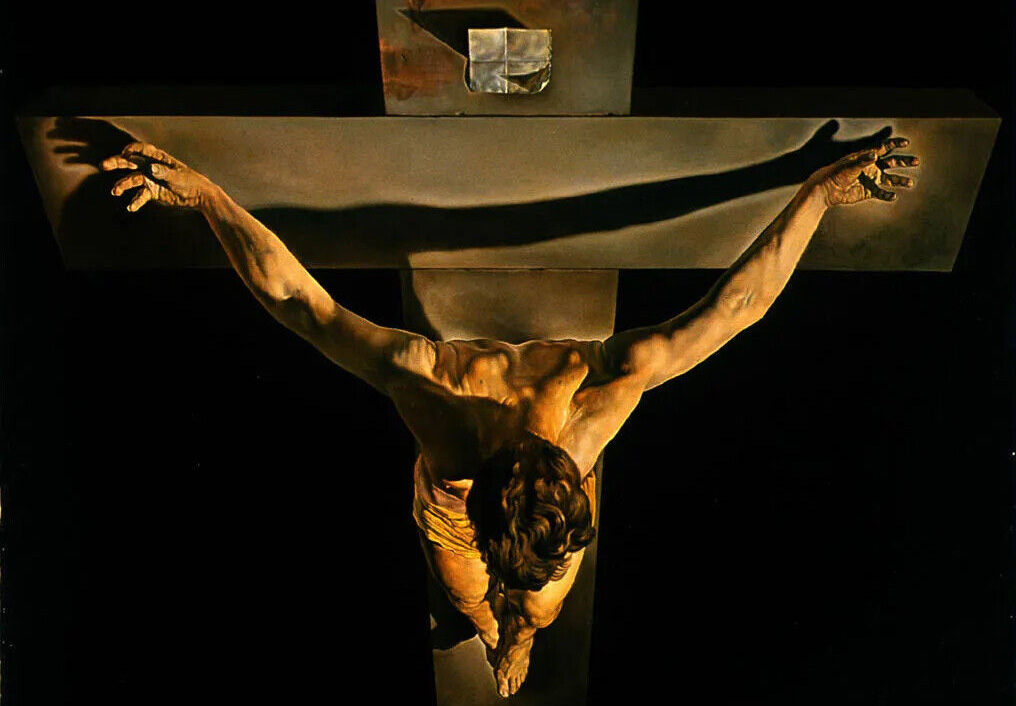
Image: Detail of Dali’s Christ of St. John of the Cross, 1951

WAIT! Don’t call me a heretic just yet, but I can’t help but wonder. Permit me to offer an alternative (hypothetical, of course) conversation:

God the Father: I’m upset. I know I gave them free will, but this is getting ridiculous. Look at how my people are behaving!

God the Son: They’re NOT behaving.

God the Father: Exactly my point! I’ve given them commandments, prophets, examples – I mean, look at King David, for Your sake, he sent his best friend off to be killed in battle and still I blessed him. Why don’t they believe I love them? Why don’t they ACT like it?

God the Son: I think it’s called “human nature.”

God the Father: Yes, but I made them in our image and likeness! I set up this glorious world and they keep messing with each other. I just don’t know what to do to show them how much I love them, and how I would LIKE for them to treat each other. They love living in the darkness! They need to see the light!

God the Son: Light… LIGHT! I have an idea! I could go down there…

God the Father: Hmmm, that’s a thought! You could show them how to live, how to love one another, how to forgive…

God the Son: Yes, and add some miracles so they’d pay attention. I am the light of the world, after all.

God the Father: Absolutely. But – they are fickle. How many prophets have they seen doing miracles and issuing warnings? And still they’ve ignored them!

God the Son: Well, I have an idea that goes beyond anything any of the Prophets did. Let them kill me.

God the Father: WHAT?

God the Son: Seriously. They need a really, REALLY BIG example of just how much they are loved. They really won’t believe it any other way. If they think that the ultimate blood sacrifice – me – has been given for the forgiveness of their sins, they’ve got to listen, don’t you think? That would be a real, heavenly, cosmic slap-upside-the-head!

God the Father: Hm. Wow. You know, that’s really not necessary for us to forgive them, but –

God the Son: I know. We’re going to love them no matter what, and do everything possible to get them all home to heaven one day, some way. But this will be a shortcut. If they follow me, they are following God. If they look at how I live and see me as an example, follow me and accept my sacrifice, they will be bringing home the Kingdom of Heaven on earth!

God the Father: You know, this could be a way to bring all of my creation into my fold – not just the children of Israel.

God the Son: Can you think of a better way to show them that God suffers with them? Like, right along WITH them, when they suffer?

God the Father: No, I can’t. But…are you sure you want to do this? You know I don’t require anything to love and forgive humanity; but I want them to realize how much they are loved, and for them to show and live that love. Doing it like this will wake them up…but…it’s gonna be bloody. And really, really painful. Those Romans are a real piece of work. Sometimes I wonder if the whole free will idea was a mistake…

God the Son: Well, you said yourself how off track they are. They have ignored the commandments and have been hurting each other. And the Romans are bad enough – and what about those Pharisees and Saducees? They’ve missed the point! Anyway, do you think the people would pay attention to anything less than a really, really BIG sacrifice?

God the Father: Good point. But you know…seeing the Son of God die a horrible death can’t be the end of the story.

God the Son: We’re thinking the same thing —

God the Father: Well, of course – we ARE God, after all! After you’re “dead” and “buried,” you’ll come back to life! Resurrection!

God the Son: Yes! Their bodies die, but they’re not sure about what happens after that. I can show them that death and sin are conquered. Rising from the dead? They’ve GOT to pay attention to THAT! That will show them that through me, they have life eternal.

God the Father: Perfect. If this doesn’t wake them up, I don’t know what will.

God the Son: One last thing: In the Torah, there are a LOT of commandments. Maybe we could just…simplify it. You know, love God and love your neighbor. They do have short attention spans.

God the Father: You’re right. I always have had fun with Words…. Let’s get the Holy Spirit in on this plan and get started.

~~~~~~~~~

So, there you have it. This might raise an uncomfortable question: Did Jesus have to die?

We’re so used to saying yes, He had to die for our sins!

But wait – did Jesus have to die because God the Father demanded a sacrifice? Was it atonement?

Or did he have to die because we humans just would not believe or accept God’s love for us any other way?

You decide.

*disclaimer: The warped theology presented here is purely the musing of this author and not to be interpreted as any official stance produced from her Jesuit education (it’s not completely their fault I’m a bit heretical), Catholic school studies or 30 + years in the Episcopal church.

God’s…pronouns?

Last week, someone sent me an article with the shocking title “Church of England considers abandoning Christianity.” Well, the CoE has done some wacky things, but this?

I ignored the sensationalist headline and read the article. There is upset that the CoE wants to use more “gender neutral” pronouns. This, the author says, goes against Jesus’ teachings, as He referred to God as “Father.”

I’m a bit wrung out with pronoun quibbling these days, so please forgive me for rolling my eyes a bit.

I can understand where the author is coming from. I also think there is a lot of energy going into something that is….well (IMHO), a bit petty. (Now, if you want to talk about some of the other things the CoE has focused on recently, go right ahead!! But this post will focus on the pronoun discussion. God’s pronouns, that is.)

I’ve never had a problem referring to God as “He.” (I also don’t freak out if you refer to God as “She…” and please bear with me before you scream “heretic!”) I don’t have a problem (at least not yet!) with so-called gender neutral language as long as it doesn’t get cumbersome. To me, “God” doesn’t imply gender one way or the other.

In my mind, to assign a pronoun to God is to attempt to humanize that which cannot be humanized. And it’s natural for us to do that, for how else are we going to wrap our simple brains around the idea of God?

“But Jesus called God his Father!” Yes, and how can we possibly argue with that? Of COURSE God is our Father! God is also our Mother. God is much, much more than we can imagine. And isn’t that glorious?

Jesus alone intimately knew the nature of God, and – I would suspect – realized that our feeble human brains could NOT possibly comprehend this nature. “Abba” summed it up. So did Father. (I wonder how the audience would have responded to Mother)

I also wonder about the response if Jesus had said “Father and Mother.”

Although…perhaps his listeners would have gotten that. They would have been familiar with this creation story in Genesis:

Then God said, “Let us make mankind in our image, in our likeness, so that they may rule over the fish in the sea and the birds in the sky, over the livestock and all the wild animals, and over all the creatures that move along the ground.”

So God created mankind in his own image, in the image of God he created them; male and female he created them. (Genesis 1:26-27)

I’ve often encountered the supposition that the Holy Spirit is, in fact, feminine in nature. One could say that to categorize aspects of God as “male” and / or “female” is simplification. It is, but our human brains need simplification. And we naturally understand the aspects of male and female.

When you get down to it, we can’t fully know the mind of Jesus; but we can follow Him and study God’s word. While we can never (in this life, anyway) fully understand the whole nature of God, we can know that God is both Father and Mother, Creator and Birther, Redeemer and Comforter, a Glorious Mystery. We believe in the Trinity, and know that God is all of these and so much more. I really don’t think God will be offended if someone uses a wrong pronoun. Those pronouns are for our comfort. Remember: God often calls us to step out of our comfort zones.

This is just my opinion, but…to sum up God with a pronoun is like putting limits on what is Limitless, Eternal, and Beyond all Knowing.

Y’all keep on quibbling about pronouns, I’ll just continue to work on my relationship with God and pray for this broken world.

Let it begin with me

I was listening to early morning talk radio when a caller made me say “yes. Thank you for reminding us all.” The topic was the Great Question of Why is the World and the Country Going the Way it Is and What Can We Do? His response was something I’ve written about before.

We can be kind. Really, truly kind. We can be Christlike. We can show love.

Sadly, an oft-repeated response to this attitude is “thoughts and prayers are useless! It’s not that simple. Pollyanna! We need ACTION! We need new laws! We need a revolution! We need…” something.

We need God.

Really, truly, that’s all we need.

We need God because we are humans, and are broken, imperfect beings. Our society used to recognize this. The problem is that we no longer do. Everywhere we look, we are being told that the world is filled with victims, and “it’s not their fault.” We are told that we deserve XYZ. We’re told that entry level and part time positions deserve a “living wage.” We’re told it’s OK for some to do all the work and others to do none. For some, nothing is their fault; for others, it seems like everything is their fault! We’re told we can be “part of the problem, or part of the solution.”

And then we’re told – by someone or a multitude of someones – how we should fix it. We need to support X, agree with Y, take a class, put a sticker on our car and stand in solidarity with the Thing Of The Week!

Frankly, it’s exhausting.

Whatever happened to simple kindness? Whatever happened to treating people as you’d like to be treated?

Whatever happened to loving our Creator with whole heart, soul and being, and loving our neighbors as ourselves? Sounds overly simple? Are you thinking of “well, I do that, but as for these OTHER PEOPLE….” You’re missing the point.

None of us can change the world…yet we ALL can change the world.

See God in every person you encounter, for God is there. (I know, sometimes God is hard to see in certain people!!) It’s difficult; we are often stressed and rushed. But if we take the attitude that “these other people will NEVER do that!” then we’ve already lost.

Is there so much going on in our minds, in our lives, and on that blasted phone that we don’t have God present in every breath?

If we did, we might pass on that spark of peace to someone else, and you never know what effect that will have.

All any of us can “control” is ourselves – and that’s hard enough. We are misguided when we think that just one more regulation, one more law, one more company or organization, one more control, one more governmental program, more money, a bigger budget, etc. etc. etc. will make things better. These are lies and false promises, and I’m not being political here – this is spiritual warfare. “Good vs. evil” may be trite, so think of it as “God focused living” vs. “Hate focused living” if you like.

It’s not always easy. We can be going along peaceably, being kind, and then the customer non-service representative with some company sends us into a meltdown (I’m guilty). We can be accosted by a neighbor demanding we sign a petition / trim a tree branch / get rid of the dog. We can tune into media and be blamed for something we have no idea what they’re even talking about….

This is where we really need God. I can’t do much of anything about those situations – except try to inject some love and Christlike action into the situation. Will it change things? You never know. Maybe one time in a hundred it will…but that’s a start.

Change starts small. Let it begin with me.

Woke?

Jesus was “woke.” Or…was he?

According to that bastion of knowledge, Wikipedia, “woke is a term referring to awareness of issues that concern social justice and racial equality. Originating in the United States, it has also been used to refer to awareness about broader social inequality on issues such as gender and sexual orientation.” Wikipedia, accessed 7/6/21.

Well, Jesus was certainly concerned about unqualified justice and equality. As for prejudice, well, just ask the Samaritan woman. According to this definition, Jesus was a pretty woke guy.

So I wonder how he’d feel about so many corporations and highly visible individuals who fall over one another in order to display their wokeness (or would that be wokedness)? I don’t know about you, but I’m getting pretty tired about reading that “Company blah blah is proud to support fill-in-the-blank.” Well, goody for them.

Don’t get me wrong, I’m not at all against corporate (or other) donations, and they certainly deserve to have a thank-you sign or banner at the ball game or their name on a teeshirt or a big thank-you plaque. I also really appreciate that some companies have causes that are sincerely close to their heart, and they spread information about their causes through their business (such as the Dave Thomas Foundation and Wendy’s Hamburgers).

But I roll my eyes when wokeness is clearly an afterthought. I wonder about those company board meetings: “Quick! Who’s in the such-and-such category can we give some money to so we’ll look like we’re not the robber barons that take home millions in bonuses every year? How fast can we get it on the Twitter feed?”

Jesus spoke about this:

“When you give to needy people, do not announce it by having trumpets blown. Do not be like those who only pretend to be holy. They announce what they do in the synagogues and on the streets. They want to be honored by other people. What I’m about to tell you is true. They have received their complete reward. When you give to needy people, don’t let your left hand know what your right hand is doing. Then your giving will be done secretly. Your Father will reward you, because he sees what you do secretly. “When you pray, do not be like those who only pretend to be holy. They love to stand and pray in the synagogues and on the street corners. They want to be seen by other people…

Matthew 6:1-5, NIRV

Do not be like those who only pretend to be holy.

Wise words from the original “woke” guy.

How Can I Keep From Singing?

Submitted to the DAR Women’s Issues Essay Competition. It received state honors (Louisiana). OK, Charlotte, here it is. 

I suppose I’ve come to that “wise woman” part of my life, even though I don’t feel wise. I am a wife, mother, office manager for my family business, songwriter, and vocalist. I am occasionally asked for advice by young singers.

I tell them that a vocalist can never replace their instrument. If it gets damaged or broken, we can no longer sing – or we must find a way to deal with the damage.

sing 1

This is the story of my own damaged instrument. Not my voice, but my ear. My advice to young vocalists has expanded to include: If you ever experience sudden hearing loss, it is a medical emergency.  I tell them about the symptoms of Meniere’s Disease.

I juggled singing with job and family life. I sang with my blues band, at my church, at our local Jewish temple, and with my music partner in our Gospel duo. God makes each of us an instrument, and I did my best to learn to use and care for my musical instrument. Call me “Queen of the Earplugs;” I treasure my ears.

sing 2

Earplugs don’t help with allergies, though. For years, I’d have occasional bouts of clogged ears and dizziness during high allergy seasons. One December day a few years ago, my ears clogged.

I thought it was allergies, or possibly I’d caught my husband and daughter’s virus. I had things to do at the office and two sick ones to care for. I knew what this was, took ibuprofen and antihistamines, but it got worse.

I couldn’t hear anything clearly in my left ear. While it had been several years since my last “spell,” I’d had a severe dizzy day recently, so I saw my ENT, who was familiar with my history. I expected the usual cortisone pack, but this time he looked at me with concern when I told him this had lingered for three weeks.

I knew from his expression that something was different this time. This should have run its course by now, he said. He prescribed cortisone and an antifungal.

“When will my hearing return?” I asked.

“Let’s wait and see what the medication does,” he replied.

I took what felt like a never-ending course of cortisone and Valtrex.

After a month of medication, Dr. Robert ordered an MRI. Fortunately, there was no tumor, but no answers either. I went to the audiologist for a baseline audiogram. There was nothing but noise and pain in my left ear. Results? My right ear was good, but my left ear showed a profound hearing loss. I took a copy of the report home, filed it away, and cried. I cried me a river, as the song says. How ironic.

sing 3

I told only family and closest friends. I quit scheduling band gigs; even with earplugs jammed into my ears, I was afraid to take any chances. Meanwhile, a bizarre group of sounds had moved in where my hearing used to be: Tinnitus. In different keys. All at once.

Dr. Robert had told me that we needed to wait a year, as there was a chance that my hearing would return with time. Meanwhile, I had this invisible, sudden, crippling loss that I couldn’t even talk about or escape. After asking my husband to repeat something for the third time one evening, he voiced his frustration. “Are you DEAF?” he cried.

I fell apart.

“YES, I AM.” I replied. “In one ear. Half of everything I hear is GONE.” He felt terrible. So did I.

I began telling a few people about my loss. I was shocked at some of the responses.

“Well, I guess so, all that loud music you play!” A laugh. “I could have told you THAT was going to happen!”

Really? I’m the one wearing earplugs, remember? I have the small band that is known to be considerate of noise levels.

My response was anger. Then, there was the well-meaning advice about earwax, about this doctor, that diet, this treatment, etc. No, a cochlear implant would only destroy the way I hear music.

That year was one of adjustment, resignation, and hope. In many ways, I had to relearn to sing because I had to learn how to hear again. Our brains are wired for stereo, and that was lost to me. I quit going places where a large group of people gathered because I could no longer discern voices in a conversation. I quit going to movies and concerts and any live presentation because they were hard to follow. Everything was a wash of noise, coated with a blanket of anxiety and occasional panic.

I considered hearing aids, although I had no idea how to pay for them. We had two children in college. This was hope, though: One day, I can get hearing aids. 

I longed to hear in stereo. I wanted the safety of knowing where a sound originated. If someone called my name, I had no idea of where to turn. I don’t know where a siren or horn is coming from in traffic.

I wanted to hear music in stereo.

When the year was up, I went back to Dr. Robert and the audiologist. I was hopeful, as Erica, the audiologist, had successfully fit my father with hearing aids. I was determined to put up with whatever adjustment was needed. Surely no hearing aid noise could be more obnoxious than tinnitus!

The testing was similar to a routine audiogram. Erica explained that the noise and sounds and speech I would hear in the headphones would be adjusted just as it would be with a hearing aid, so we would find out whether or not a hearing aid would help me.

Whether or not? I hadn’t realized there was a chance that this wouldn’t work.

Today’s hearing aid technology is phenomenal. From what I knew about audio engineering, the ability to adjust amplification of specific frequencies in a device so tiny was nothing short of a miracle.

Unfortunately, this miracle was not to be mine. No amount of amplification or adjustment made a difference – only physical pain. I sat in Erica’s office and sobbed as she held my hands and offered tissue, understanding, and honesty. The cilia, the microscopic hairs of the inner ear that enable us to hear, were dead. No diet, supplement, medication, procedure or technical device would restore them. I faced a life in monaural, but at least I had one functioning ear.

She also offered a tentative diagnosis: Meniere’s Disease. My decades-long history of periodic dizziness was a clue. I’d had several particularly violent dizzy periods in months preceding the hearing loss. During the worst dizzy periods, I always spun to the left. I had become so used to a dizzy period during high-allergy months that they just became a part of life, diagnosed previously as “Benign Peripheral Vertigo.”

I learned about Meniere’s Disease, and saw my history written in what I found. Dr. Robert’s suggestions to address the vertigo were basically the same as for Meniere’s, but I felt defeated as I learned that no one knows the cause of the illness, and there is no cure. My years of periodic spells, interspersed by periods of feeling normal, had a name. Interestingly, it affects more women than men, and the possible causes include infection, allergies, head injury, stress, fatigue, migraines, respiratory infection, and an autoimmune response. I wasn’t too surprised that women experience Meniere’s more than men. It usually affects one ear, but sometimes attacks both over time. I cannot dwell on that. It is critical for me to maintain my balance, and I mean that metaphorically as well as literally.

balance

Balance.

It’s not always obvious that I have a hearing deficit, but an astute observer will notice. I’m getting better at lip-reading. In music, I seek the right position to hear what I need to hear in order to sing. In any group seating situations, I tell the person on my left “I’m deaf in this ear. If you say something and I don’t respond, it’s because I didn’t hear you.” I’ve learned to deflect the still-painful topic of hearing aids by saying “it’s a sensorineural hearing loss, which cannot be fixed by a hearing aid.” I’ve learned that such queries are usually out of concern.

I also tell others that sudden hearing loss is a medical emergency, even if you’ve had it before and you think “oh, allergies.” I also tell them about Meniere’s Disease.

On the positive side, the dizzy spells have mostly stopped; this, too, is typical of Meniere’s. As for singing, I’ve had to hyper-focus my sense of pitch, which has strengthened my vocals. I’ve heard of other vocalists who have experienced a similar hearing loss who have quit singing.

I can’t not sing. I have found a new way of listening, and a new way to focus on the experience of singing. It is a whole-body expression, as you must feel the vibrations and melody in your body. Your mind, throat, ear, mouth, lungs must know how the notes feel as well as how they sound. Perhaps it’s similar to the heightened sense of hearing that some vision impaired people have; I am partially deaf, so I have an enhanced sense of certain facets of singing that some take for granted.

Cedartown680

How can I keep from singing? At a Women at the Well concert. Photo by Rev. Kemper Anderson, at St. James Church in Cedartown, Ga.

About three years into this journey, my music partner and I were preparing to go on a short tour of several churches in the mid-Atlantic states, performing our original Gospel program about Jesus’ women disciples. We had recorded several of the songs from the program, and I longed to re-record some vocals and add harmonies.

Singing overdub harmonies is a challenge when you have only one functional ear. I managed by notating the harmonies, placing the headphone behind my one good ear, and forging ahead in spite of fear deep in my soul. What if I couldn’t do it?

But I could, and I did. A few days later, after the vocals were mixed, we shared the tracks with a friend. Danny is a gifted pianist who tours worldwide and has done a lot of recording and harmony vocals. He knows of my hearing loss, and was floored when he heard the harmonies.

“That’s a miracle,” he said, “that you could do that.”

It is a miracle, and one for which I am profoundly grateful. I still ache over the loss, but on the other hand, I now sing more sacred music and chant. Sometimes frustration still rises to the surface. That’s when the words and music of the hymn How Can I Keep From Singing sustain me:

Through all the tumult and the strife, I hear the music ringing

            It finds an echo in my soul. How can I keep from singing?