Creating Space

It all started some years ago (and no, I’m not saying how many) when I signed up for Zen class with Fr. Ben Wren, SJ. I’d always had this sense of being “beyond” my physical body, and meditation seemed a way to connect with this aspect of myself. (That, and I’d really enjoyed the fascinating-but-challenging history class I’d had with Fr. Ben. His exams featured fun things like “draw the Eurasian land mass and label it. In Chinese.” OF COURSE I wanted to take his Zen class!!)

At this point, you may be expecting to read that I fell in love with Zen meditation. Well…not exactly.

I loved the class, and loved the challenge – and wow, was it a challenge. Having inherited a swayback from my mom, it wasn’t quite possible to sit with spine straight. Being a college student, my mind wandered – a LOT. (It still does, and I haven’t had that college student excuse in a long time.) I did, however, learn that there was a whole ‘nuther world inside (and beyond) my mind, and I have explored methods of meditation and expanded consciousness ever since.

When working in my chosen profession as a clinical social worker, I often taught relaxation and meditation techniques. That’s when I learned that just about anything can become meditative, depending on how we approach it. Washing dishes? Well, if you think about your long list of chores to do after the dishes are done….mmm, no. But if you think simply of washing the dishes, it can become meditative. It’s (dare I say it) being mindful.

Today, “mindfulness” is a buzzword. So is “being in the moment.” But meditation is an ancient practice, and people did it long before anyone had a name for it. Yet social media would have us believe this is The Best New Thing. It’s even become a bit confusing because there are many meditation techniques and methods.

Something that I found helpful on my meditation journey was guided meditations. Thanks to apps and the internet, there are many guided meditations available – some free, some paid for. I’ve lead many a group and individual in guided meditation, and it is a fun (and creative) method. You’re doing something – but you’re focused. (The big challenge with Zen and similar forms of meditation is to empty the mind. Our minds get bored very, very quickly – a characteristic that social media loves to exploit.) With guided meditations, the conscious mind is engaged just enough to quiet the chatter – and it can be very, very relaxing.

Centering Prayer is another popular type of meditation practice. One chooses a word or phrase with spiritual meaning and focuses on that. As with most other meditation practices, if random thoughts arise, they are observed and released, and one returns to the word/phrase. Examples include “Lord have mercy,” “The Lord is my shepherd,” etc.

“I can’t meditate, I can’t sit still!” I can relate. Fortunately, there are ways to move in meditation, and I’m not just talking about yoga (although that’s one wonderful method to get INTO your body and out of your brain). A walking meditation is wonderful. Take a walk outside and leave your phone behind (or set on airplane mode) and just focus on what you see. Observe. If you find yourself ruminating about your to-do list, make a note if it’s something you need to remember and then just let it go. Return to observation. If there is a labyrinth available in your community, walk it! This is a wonderful walking meditation.

Mantra meditations are similar to centering prayer in that they involve a word or phrase as the focus. I remember talking to several devout Roman Catholics who looked very wary when I talked about meditation. However, praying the Rosary is indeed, a form of meditation. Hey, it’s all good, and we don’t have to use the same terminology.

“I can’t meditate, I can’t sit like they want me to sit.” I was told the proper way to sit for zazen, and was told “don’t lie down because you might fall asleep.” While Buddhist monks may practice for years and decades to get beyond the body’s aches, you don’t need to. Most of us will say “I can’t think of anything except how much my rear end/back/neck aches” and give up. What position is comfortable for you to relax? That’s what you want to do. If you do fall asleep, keep trying. Eventually you’ll get it.

There’s technology out there that will help you to calm your mind. Schumann frequency, tuning forks, hemi-sync , binaural beats… do a search on “technology for meditation” and you may well feel overwhelmed. The good news is that you don’t really need this stuff (although you might be interested in exploring it to see what might work best for you). Personally, I have found the sound technology from the Monroe Institute to be beneficial, even with my hearing loss. Their Expand app has free offerings, and you can find some on their website here: https://www.monroeinstitute.org/blogs/free-meditations
The beauty of meditation is that there is a way for ANYONE to do it. It’s been done for thousands of years without technology. That said, sound CAN help one enter a meditative / trance state. Some people joke about “Ommmmmmm” but humming stimulates the vagus nerve and helps one to get “into the zone.” Drumming, rhythm, chant, music – all of these have been used by individuals and groups to get to an altered state of consciousness.

Meditation is about creating space in your life and in your awareness for silence and contemplation. I think the explosion of mindfulness awareness and meditation apps corresponds with the explosion of distractions in our daily lives. The more distracted we are, the more out of touch we become with our inner selves, and with Divine Love. We must make time for rest, reflection, and recharging. Jesus rested/prayed/meditated often. (Among others, see Luke 5:15, also Mark 6:46 – feeding the multitude was a long day!)

I’m often asked the difference between prayer and meditation. In a sense, it depends on how you define each word. Do you define prayer as “talking to God?” Interestingly, some people say they don’t believe in prayer, because what they ask for doesn’t happen/horrible things happen in this world. But this mindset means that prayer is only a petition, a request. And while there’s nothing wrong with that (and certainly nothing wrong with praying for peace – the world needs all the help we can get!) if one thinks of prayer only as requests, then no, it’s very different from meditation.

In this instance, one might define meditation as “listening to God.” But really? Meditation is just being present. With yourself. With God/Divine Love/Source. With All That Is. Just…being, without expectations, without striving, without pretending. And we all need that space.
Discombobulated.

We’re all a bit discombobulated these days. Even for those who are still working (I am), things feel fragmented because we really can’t count on much of anything.

Which is sort of silly when you think about it – life is never certain, and I laugh every time I hear anyone in a Covid-19 briefing say “we can’t guarantee that it will be safe to…until…” or “We won’t open up again until we can guarantee the safety of….”

Seriously? Can you EVER guarantee safety? Of course not.

But…I’m tired of the fear-mongering and the blaming that is going on. Yes, Covid-19 can be very serious. It is a strange thing, as many who get it show no symptoms, or have nothing worse than a bad cold or bronchitis. Others get it, and it’s pure torture or even deadly. I’m not downplaying the severity of this virus, and with all of the talk and numbers flying around, I’m looking at some perspective.

isolation

Perspective in isolation.


The models that experts and leaders point to in decision making have been notoriously wrong. We’re told that’s because we’ve been “flattening the curve.” I don’t know if that’s really the reason, because I don’t have all the data. None of us do.


I’m worried, though, about the toll this is taking in mental health, and there is very little talk about it. Why should I be surprised? Mental health comes into play when there is a celebrity suicide or a mass shooting, and then it goes lurking back into the shadows again. This is something that has concerned me for years; I am a Licensed Clinical Social Worker, no matter when/where/how/if I am practicing currently, I keep my license and continuing education active.

For perspective:

As of April 20, the CDC reports 746,625 cases of Covid 19 in the United States, with 39,083 deaths attributed to the virus. These numbers include “probable” cases. This is since 1/22/20, when that tracking began. (Note that the deaths include people who had the virus, not necessarily who died OF the virus.)

Now, let’s look at the 2017 – 18 flu season. (Yes, I know it’s not the flu. Bear with me a minute, OK?) Here are the CDC’s estimated rates of influenza-associated disease outcomes for all ages in the US:

44,802,629 infections

20,731,323 sought medical attention (that is, saw a doctor: Do I have the flu? Yep.)

808,129 hospitalized

61,099 deaths

But, as we are often reminded, Covid 19 is NOT the flu! We have a vaccine for the flu. (No, not really, but we have a sometimes-more-effective-than-others “shot” for the flu that is called a vaccine.) Wow, a good thing we have a flu shot, that keeps the numbers down to just…45 MILLION infections!!)

For more perspective, the National Safety Council notes that in 2018, 39,404 Americans died in automobile accidents.

For even more perspective, the CDC notes that every day, approximately 123 Americans die by suicide.

That’s nearly 45,000 Americans a year who choose to take their own lives.

SAVE.org (Suicide Awareness Voices of Education) offers training to the public as well as to mental health and health professionals. They compile statistics from the CDC, NAMI and others, and those stats are even more grim than when I earned my MSW three decades ago.

Suicide is the 10th leading cause of death in the US for all ages. (Where does Covid 19 fall? I’m just curious.) Depression affects 20 – 25% of American adults in any given year, and only half of Americans who have a major depression episode (which is VERY different from “the blues,” reactive sadness, grief, etc.) receive treatment.

new gym

What will each day bring?

So what does this have to do with Covid 19?

My personal opinion, based on professional experience (aided by logic and an understanding of human nature) is that the effects of prolonged isolation, job loss, and downright economic disaster is going to have repercussions that may be even greater than those of the virus.

A recent article in US News & World Report noted that suicides have gone up by 35% in the last two decades. Jonathan Singer, the president of the board of directors of the American Association of Suicidology, noted that many “deaths of despair” happen in rural areas where there are fewer economic opportunities.

“Poverty breeds hopelessness, loneliness and depression, all emotions that increase the risk for suicide.”

Right now, most of the country is shut down. Following a great period of job growth and record low unemployment, many Americans were feeling optimistic about opportunities, work, and a chance to get ahead.

But now we have an economy in freefall, with over 22 million filing for unemployment, millions of Americans scared to death over a virus that hasn’t been anything like what was forecast, and poverty is getting up close and personal with a LOT of people. The models used to “predict” what was to have happened with Covid 19 haven’t been right yet.

But we can’t end these shutdowns yet! The infection rate and the death rates will go up!

BUT…the whole idea behind “flattening the curve” was to avoid overwhelming the health care system. I think we can safely say that we’ve done that. There will be people who point to increased infection rates (when things are “open” again) and say “see? We moved too soon! Disaster is on the horizon! Shut it back down again!!

The longer things are shut down, the more likely people will be to swarm everywhere they can once things are “open.” And yes, we will no doubt see more infections and , sadly, deaths. (I am interested in following the clinical trials on hydroxychloroquine. LSU is to be doing one, and they’re not alone. Fortunately, we already have a track record on that drug; it will primarily be a question of investigating its efficacy with treating Covid 19).

A prolonged economic shutdown breeds poverty…hopelessness…and loneliness. Those prone to depression and anxiety are going to have a worse struggle, and even those who aren’t “prone” to such things are likely having a tough time. (Let’s not even think about those poor souls with OCD! Hand-washing on steroids!)   If you’re worried about feeding and housing your family and you and your spouse are suddenly unemployed, you want to get back to work. For many small business owners, this economic slide means the end of their dreams.

But the danger…

Well, that’s why I included those flu numbers. We don’t freak out over the flu. We wash our hands, don’t go to work when sick, and do our best to stay healthy and not think about this deadly disease that kills tens of thousands each year. We could catch the flu, even if we had a flu shot. (It’s happened to me.)

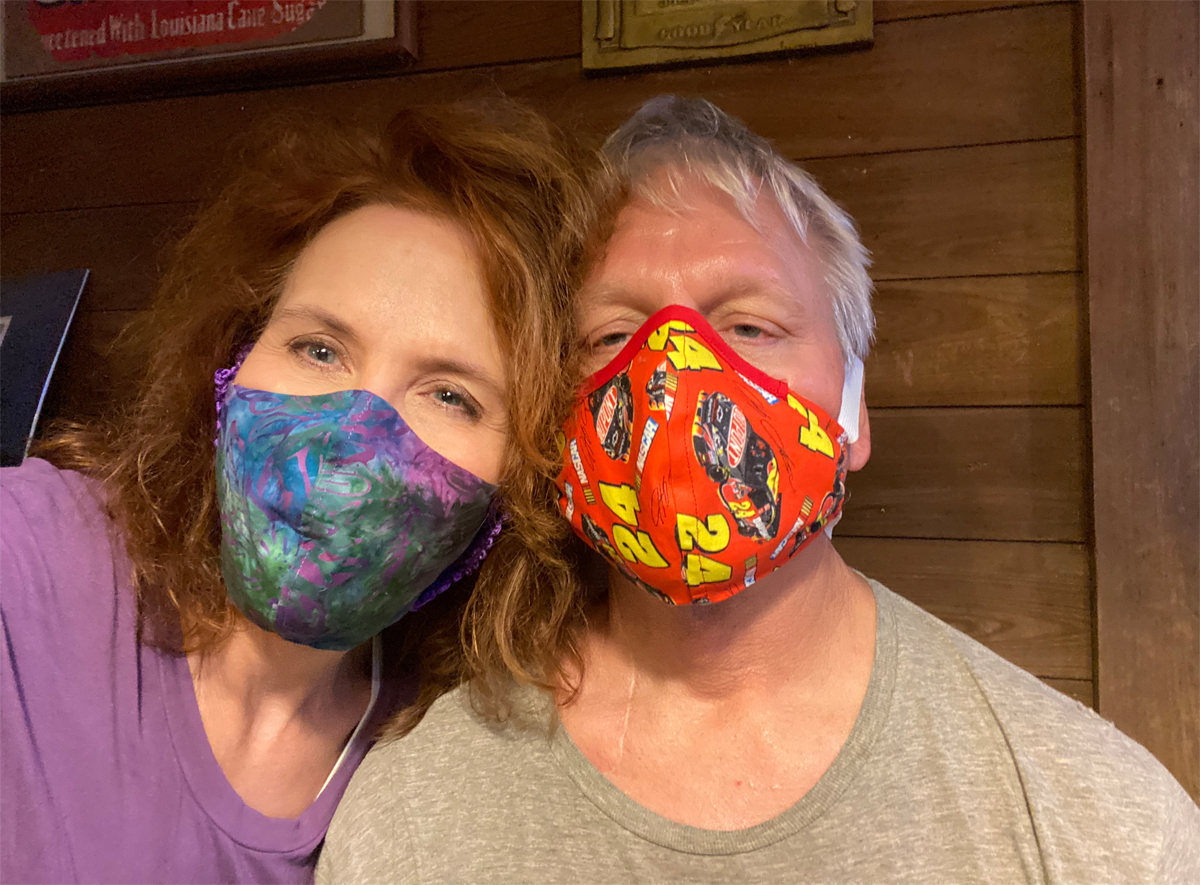
masks upload

We do our best to stay healthy.

We don’t freak out over the prospect of dying in a car accident. We put that out of our minds, buckle up, check the rearview mirror, and drive to work.

I can promise you that somewhere in this country, right this moment, there is someone (and no doubt more than a few someones) worried, fearful, and in despair over the economic downturn. They may never have had to apply for any assistance before, and are overwhelmed with the “system” and the amount of paperwork they suddenly have to deal with.

Some are lost in the black hole of depression and desolation – and decide that’s it, and become another suicide statistic.

Stop reading for a moment and say a prayer for those souls; may their hands be paused from taking further action and may they reach out to someone for help.

Remember, risk is something we must live with every day, in everything we do. No one can guarantee our safety or wellness, not even the most respected doctors. The best any of us can do is mitigate the risk the best we can and carry on with life, and lend a helping hand to those who need it.

But please, let’s carry on with life; for ourselves, and for each other.