Singing Bowl 2

I recently wrote about how a singing bowl came into my life.  I’d wanted one for a while, but didn’t really know where to find one, and wanted to choose one “hands on.”  I found the bowl (or rather, it found me) at the Summer NAMM show in Nashville in June.
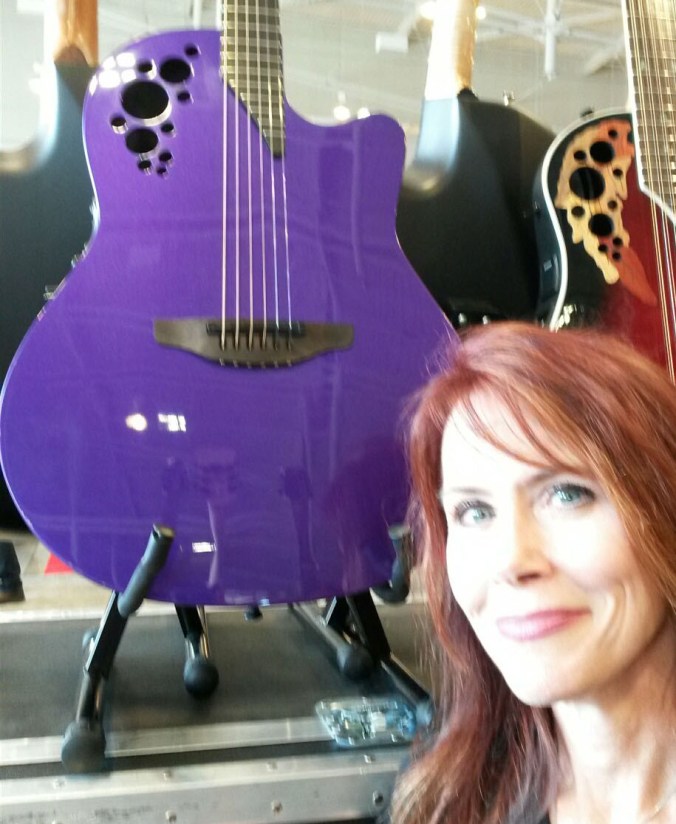
20160623_164641_resized_1

This lovely purple Ovation guitar also found me at NAMM, but unlike the bowl, didn’t follow me home.  whew.

The day I found the bowl was a Friday, and the next afternoon we were scheduled to play a concert featuring selections from Women at the Well at Grace Episcopal Church in Hopkinsville, Kentucky. We left the NAMM show  at 6, ate supper and decided to do a quick practice.  We use backing tracks for some songs and had recently decided to switch to using an iPad for tracks, and wanted to make sure everything went smoothly as technology has a tendency to invite gremlins and other “ghosts in the machine.”

One song (without tracks) is titled Our Father, Our Mother. It has sparse instrumentation, is a paraphrase of the Lord’s Prayer, and is…well, a chant. When I wrote it years ago, it came to me easily and suddenly. I love the song, and love singing it.

We moved quickly through the set, reviewing all songs with tracks first to ensure that the iPad would behave.  So far, so good.

Then, I had an idea.

“Hold on a minute,” I told Bubba, and walked to where the bowl was sitting.  I had just bought it that afternoon, and had been enjoying its tone in a more quiet environment.  I picked up the bowl, struck it, and began singing.

Father, Mother, God, Creator, hallowed be thy name. Upon earth; thy will in heaven, be all things the same….

Bubba joined in on the keyboard.  The bowl was the right pitch for the song.  No wonder this bowl and I got along so well; I was tuned to it. I asked Bubba to keep the keys sparse, and we continued the song.  To my delight, it worked…wow, did it work. What synchronicity!
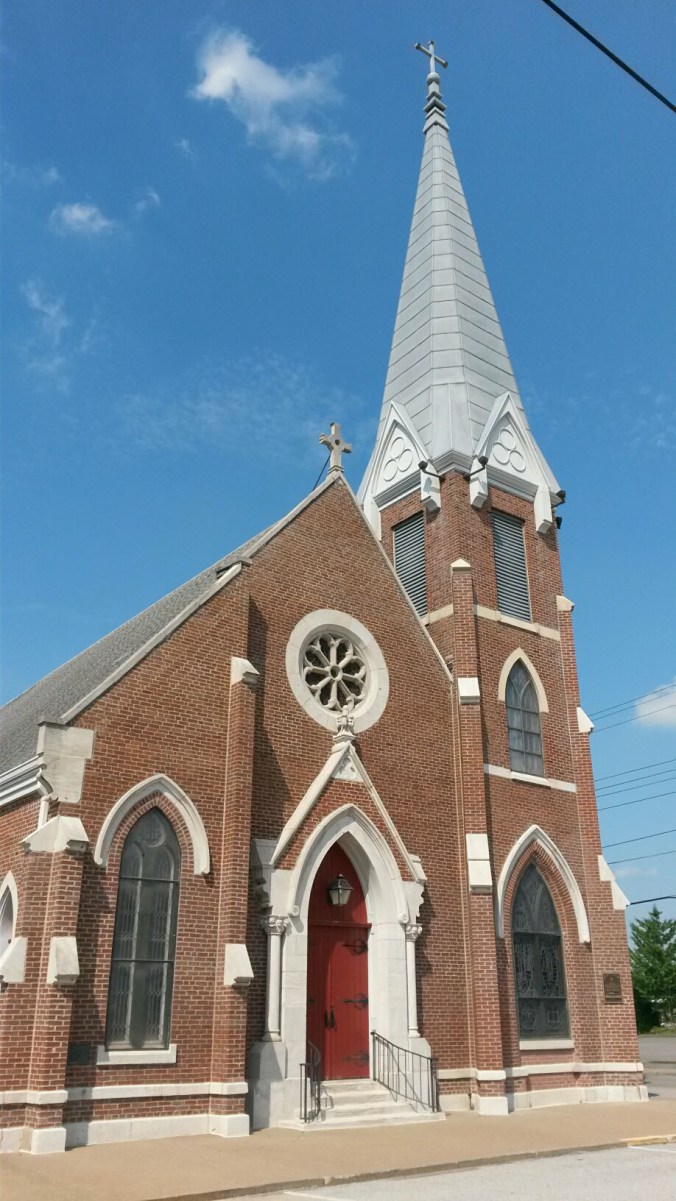
Grace Episcopal Church, Hopkinsville, KY

Grace Episcopal Church in Hopkinsville, KY

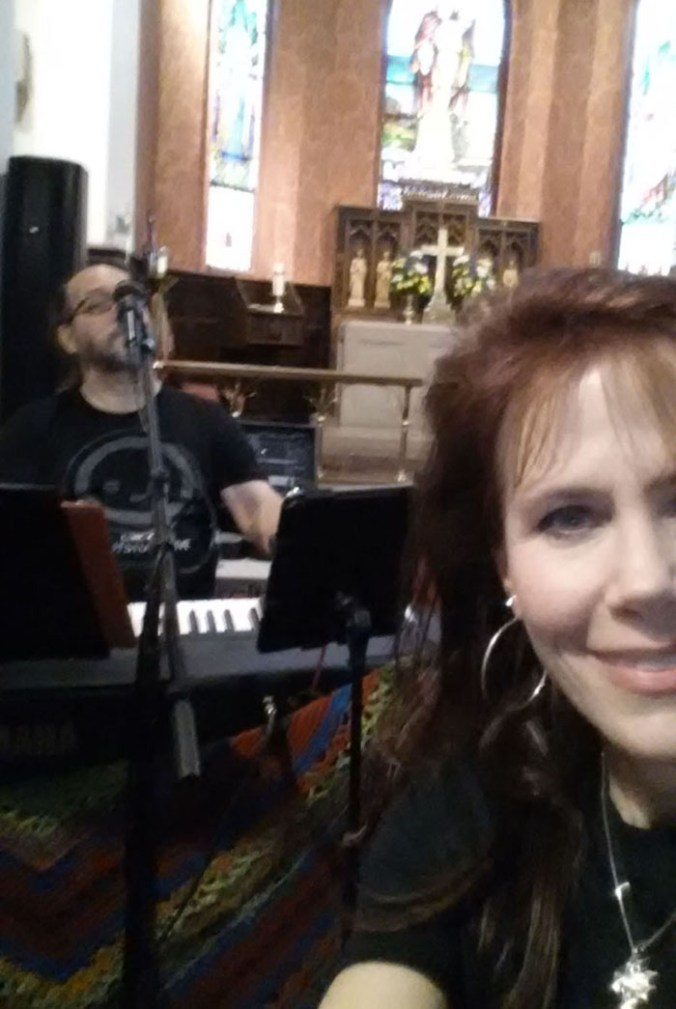
The next day, we packed up the bowl along with our instruments and headed to Kentucky. It was an easy drive, a beautiful day, and a lovely church. Rev. Alice Nichols met us, and made us feel most welcome.  I love older churches.  Not only are they beautiful, one can feel the echos of generations of worship deep in the structure itself.  We set up, and the sound of this handmade, prayer-filled bowl filled the church.
setup2

Setting up.

Even the iPad was still behaving!  We relaxed and took in the sights of this lovely church, which included panels honoring church members who had fought in the First and Second World Wars.  The needlepoint cushions at the communion rail were filled with rich symbolism, and the baptismal font told stories of generations of new lives.

20160625_201705_resized

Some of the needlepoint at Grace Church

The evening began with a Eucharist, and then it was time for the concert.

That was the moment that the iPad officially became an iPest.  Or perhaps an iPain.  The volume control, which had behaved perfectly during all run-throughs and tests, vanished. Well, not vanished, exactly, but the dreaded greyed out.  It was visible, but infuriatingly nonfunctional.

It’s times like this that try the mettle of any musician.  Happily, the congregation could all relate to techno-glitches, and when it comes to technology, we have triple-redundant backup readily available…so we switched to the CD player. (I figured that the iPad would find its wayward volume control by the end of the concert.)

In the meantime, it was the bowl’s debut.  One strike, one tone,  and I began to sing. I could feel the vibrations of bowl and voice.  Later comments indicated that others felt the richness of the bowl in that song as well.

At the end of the concert, sure enough – the iPain worked.  We all shared a good laugh, and then a lovely reception with fellowship and good food.

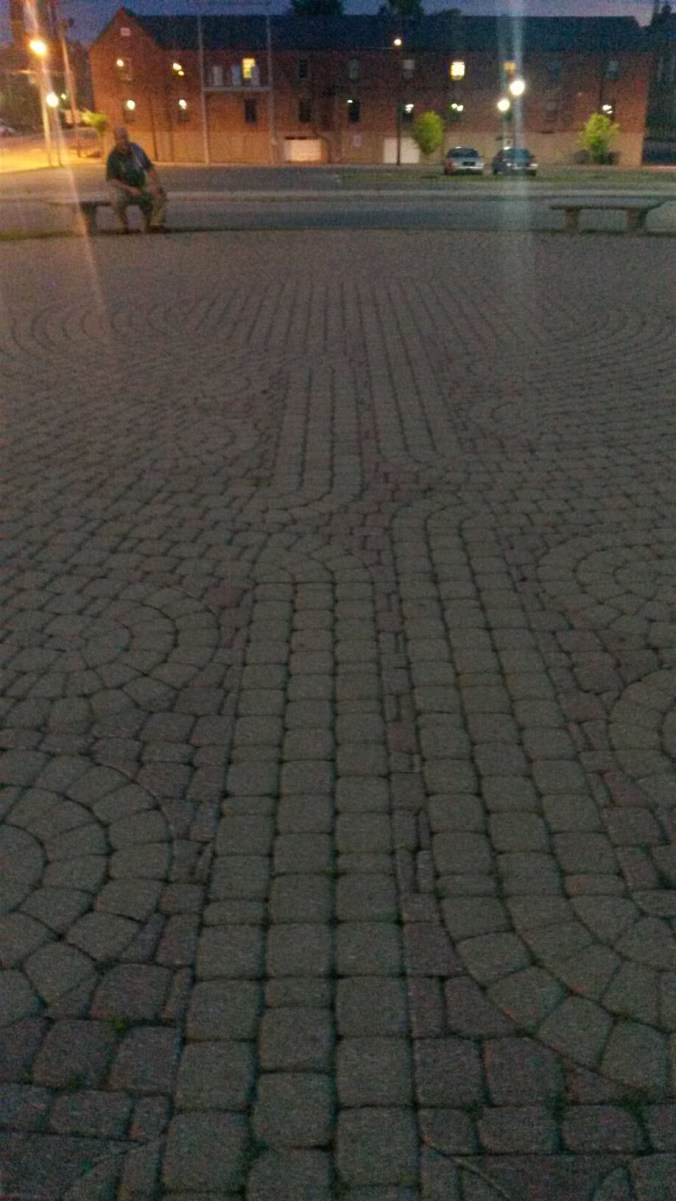
Grace has a beautiful labyrinth across from the church.  Alice and I had originally discussed the idea of performing at the labyrinth, but it had been too hot (and humid) that day. After packing up instruments and gear, we took some time to walk over and enjoy it.  I took a quick walk, breathing in the aftereffects of the concert’s energy.
20160625_203655_resized

Joshua at the labyrinth

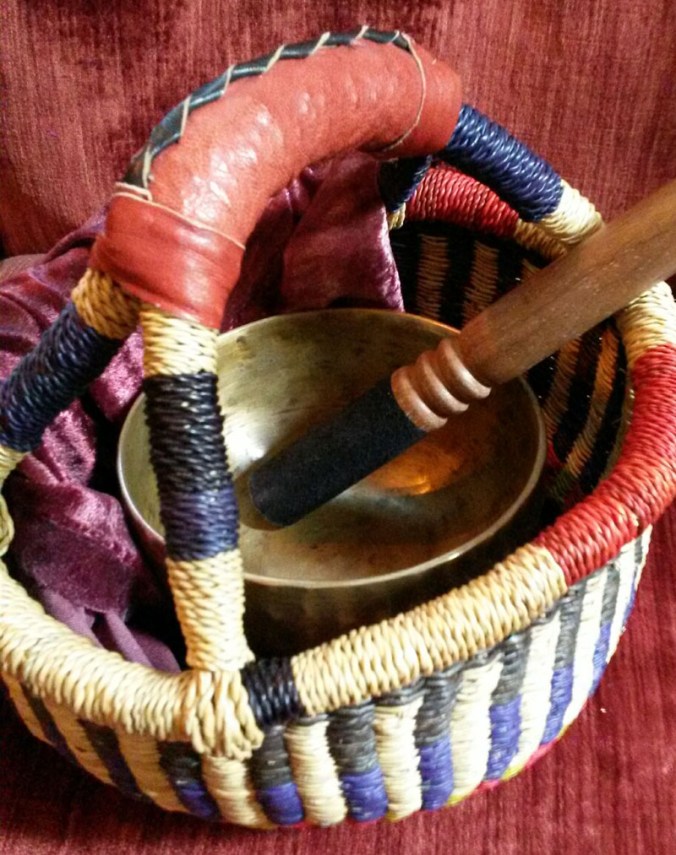
The following day, we packed up and headed south, with a stop at Moony’s Market in Monteagle, Tennessee.  We’d found this delightful health food store / gift and antique and herb / yarn shop on our April visit and performance in nearby Sewanee. Oh, the yarn! Oh, the food! I purchased a small African handbasket – which I later realized was the perfect size for transporting the bowl.  More synchronicity, or at least my subconscious mind at work.
traveling bowl

Ready to travel! And why not? Bowl and basket both have come halfway around the world already!

In addition to bringing me daily beauty and mindfulness, I think this bowl and I are meant to go places and make music together.

Thank it forward.

A friend asked me today how I can make a prayer shawl and not be too concerned about whether or not I ever receive feedback from the recipient.  Her question made me think.

There’s a certain amount of detachment, once the shawl is finished and given.  But there cannot be detachment during the making.  Be a channel, I thought.  All creativity comes from God, I’m just the hands that make the shawl and the human being that prays, however imperfectly, for the recipient.  Couple that with a thick-skinned attitude gained from years of performing with a blues band, and I suppose you have a working definition of being detached from the responses to your creative offerings.  (“You’re awesome!” “You suck!” all in the course of an evening, and maybe it’s alcohol talking. Then again, maybe I am awesome! Um, and maybe I do really suck.)

thistookforever Maybe one of these cool labels from www.sublimestitching.com would be a hint!

When it comes to our creative gifts, we can’t be completely detached, and I find myself mulling over the question this afternoon as I sweep floors and do laundry.  God has such a sense of humor.

I cannot detach as I make a shawl for someone who is in pain.  Right now I’m  working on one for a woman who suddenly lost her 28 year old daughter.  She is struggling with a pain and loss that I cannot understand, and yet I grieve and pray with her in spirit, and those prayers are woven into stitches.  I cannot detach from songs I love to sing, and especially cannot detach from sacred music. What gives me courage to sing is to remind myself that I am doing the best I can with what I am given, and the rest is up to God.

I believe it’s that way with any creative endeavor, and especially with those where there is a recipient involved.  So much of it is up to God, to the Divine Creative. Whether writing, cooking, making a shawl, making music, building or crafting something of wood…we pour an extra measure of love and heart into it. We share our soul with the recipient, whether we know them or not. We are open and vulnerable as we create, but must have a bit of a thick skin when it comes to the reception of our work – a thick skin or a constant reminding that it’s all from God.  It’s a crazy balancing act, and one that I’ve never quite gotten the hang of, either.

Sometimes I love to give anonymously because I know I’m NOT going to be thanked. I can remain unknown, and imagine someone else’s surprise.  No one feels obligated to reciprocate, say thank you, or anything. I love to think that I made a difference, even if a tiny one. When something is given anonymously, thanks can be given to God, and the recipient will “pay it forward” sometimes.  That starts such a ripple of blessings, and it’s good for me in that I cannot expect thanks.  I find that I feel blessed, and that’s thanks enough.

over the teche 2 Sometimes I do get attached to shawls.

And yeah, sometimes I want to hear “thank you.” Hey, I’m human, and I don’t think there’s anything wrong with wanting some sort of thanks or an occasional accolade.  I guess the question is, do we want to be thanked, or do we need to be thanked?  It would be pretty cold to not care at all.

We take thanks where we get them,  knowing that for everyone who says “thank you,” there are others who cannot do so. Sometimes there are no words; sometimes there is no opportunity.  To find myself wanting thanks is also a lesson that I can be grateful for.  If thanks doesn’t come, well, that’s not about me or my gift.  We can only be the channel, the conduit, for something that must be expressed, made, created, given.  Once the shawl is given, once the song is sung, once the meal is served – it’s out of our hands. Our humanness may be saddened (and that’s OK), when our efforts aren’t acknowledged. I can still be thankful that I have gifts and abilities to share. We can only learn from that twinge of “gee, did they like it?” and then let it go.  Let it leave our hands as did the shawl, knowing that the prayer and the spirit will continue to lift us – and who knows who else.

Reentry

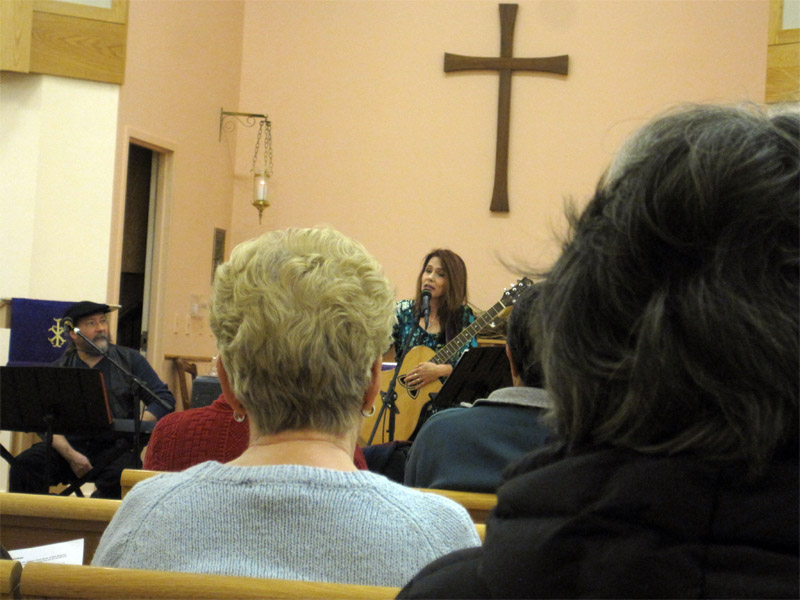
I’ve been absent from these blog pages lately.  My music partner and I returned recently from a week-long tour in Maryland, West Virginia and Pennsylvania, presenting our Women at the Well music program at several churches there.  It was a wonderful experience, and we were awed and humbled by the responses the music received.  What a blessing!  Then, home in time for the latter part of Holy Week, which meant more wonderful music in liturgy.

The tour was a stretch – it was a challenge to be in community with different congregations in so a short period of time.  You see, I don’t like thinking of myself as a “performer” in this context.  (Performing is what I do with the blues band!) I have no problem singing (or speaking) in front of people, but music focused on God is… focused on God!  I’m just the messenger, and I always hope that my technique enhances the music instead of taking away from it.

Yet, I know that not everyone feels comfortable being “in front.”  For me, it’s just a part of doing what I do.  The message is important, and I’m the one to deliver it, so…here goes.  I step up and sing and speak.

Transfiguration 1

And oh, how I long to know everyone in the room.  What are their stories?  I see individual faces, I get feelings, reactions from many…so I do know you.  Some are more guarded, some are wide open, some are in between.  Doesn’t matter to me.  I see the faces, I ride the ebb and flow, and I pray always that whatever is said and sung will bring comfort or joy or insight to someone.  It is, in my mind, a communal act – even though I won’t have the chance to meet everyone.  It doesn’t matter; we are all a part of this experience, in this moment, in this church.  And we are connected, now and into the future.

You are all part of Women at the Well, I say at the end of the event.  By being there, everyone has certainly given me a gift.  The Gift of Presence, of Witness, is awe-inspiring to me.  I tell everyone that they will be in our hearts.

And you are.

http://www.women-at-the-well.com

When in doubt…bring food.

Just a week ago I had a conversation with a couple of friends about “when in doubt, bring food.”  Whenever someone has a Major Life Event, the common response (at least in my corner of the world) is to bring a meal, a casserole, a….something edible and delicious.  I mentioned that I had often wondered if this “bring food” response is a Louisiana thing, or is more universal.  “I think it must be universal,” said I.  After all, drive-through daiquiri stands may be JUST LOUISIANA (yes, we have them) but food – well, everyone eats, right?  I was told stories by the other friends that indicated that this isn’t always the case.

Huh? This was a surprise.  If there were an official manual of Cajun Etiquette, page 1 would read simply this: When in doubt, bring food.

After all, it’s what we do.  When someone has a baby, bring food.  When someone has an operation, bring food.  When someone has a surprise, a shock, an unexpected visitor, an expected visitor (or a whole houseful of them), a new house, bring food. When you have a new neighbor, bring food.  When someone is packing to move out, bring food. And when someone dies, bring food. A meal, a covered dish, a casserole, a pot of gumbo…one brings food as a practical matter and as a symbol of sustenance.  It’s an act of nurturing, of caring and of sharing.

Bring Food

I made this for your family and mine; we don’t have to eat it together to know that we’re with you in this. We symbolically share a meal, and in a part of the world where cooking is practically a religion, the offering of a meal is sacramental: An act of grace, an expression of love. I can’t take away your burden, but I can make your life a bit easier.  I made you something that nourishes my family, I hope it nourishes and feeds your body and soul.  Have some comfort food.  Just receive; it was made with love and prayer.

If the event is a positive one, bringing food is still – always – an appropriate response.  A celebration? You’ll have company, and I know you’ll want to feed them and spend time visiting, you don’t need to be in the kitchen.  A new baby?  Rest, Mama, all y’all have to do is heat up the gumbo, and don’t forget to eat ‘cuz you have to feed that baby.  Your adult child is home from serving our country?  He or she needs some real home cooking, and you need to spend time listening, not cooking.  Eat.

Even if you are too numb to taste it, eat.  Your body needs fuel.  I thought of you and your loved ones; I prayed for you all while I chopped and cooked.  Whether prayers of supplication or prayers of thanksgiving, I thought of you as I decided what to make, selected the ingredients, and cooked.  My humble kitchen became a place of prayer as a meal for your family (and possibly mine, if the pot’s big enough) came together.

I made a lot, there’s plenty, don’t worry.  I’m not always good at saying what I feel, but I sure can cook how I feel.

Sometimes words fail us, but food doesn’t.  So when in doubt, bring food.

Prayer Shawls * 3 Dimensional Prayer

Thoughts at the beginning of a Shawl Ministry at the Episcopal Church of the Epiphany in New Iberia, La.

“Shawls … made for centuries universal and embracing, symbolic of an inclusive, unconditionally loving, God. They wrap, enfold, comfort, cover, give solace, mother, hug, shelter and beautify. Those who have received these shawls have been uplifted and affirmed, as if given wings to  fly above their troubles…”

                                  Written in 1998 by: Janet Severi Bristow    From the home page at:  http://www.shawlministry.com

prayershawl1

Wrapped in Prayer

I had a Zen teacher in college, Fr. Benjamin Wren, SJ, who taught – among other things – liturgical dance, ikebana and Tai Chi.  He called these “3 dimensional prayer.”  I thought of Fr. Wren when I started exploring the interest level for a shawl ministry at our church, because I also think of prayer shawls as “3 dimensional prayer.”

Shawls are practical, beautiful, nurturing.  Even though the idea of a prayer shawl ministry didn’t really burst into modern consciousness until 1998, shawls have been present in spiritual practice for a long time.  I think of the Jewish Talit, or fringed prayer shawl, worn at various times by Orthodox, Conservative and Reform Jews.  Our priests, deacons and bishops wear stoles when leading a service. Mantillas may still be worn by Spanish Roman Catholic women for worship (and were extremely common in French/Spanish south Louisiana in pre-Vatican II days). Pentecostal Churches may have “prayer cloths” – cloths that have been prayed over and in some cases, anointed.  All of these practices may serve to set the wearer apart, or to help the wearer indicate, even if only to oneself, that this time is now for prayer.

I can appreciate the concept of a prayer cloth.  Here’s something tangible that has been prayed over, given to someone to hold, to touch, a tactile reminder that someone else has been praying for them.  It’s a powerful thing to know that someone is praying for you, and having something in hand that underscores that can serve as a strong reminder: You are loved.  You are remembered and cared for by this community.  You are a child of God, our sister or brother in Christ, and this is a symbol of our ongoing prayer.

A shawl is this symbol, that wraps one in a comforting embrace.  So where did our 21st century concept of a prayer shawl ministry come from?

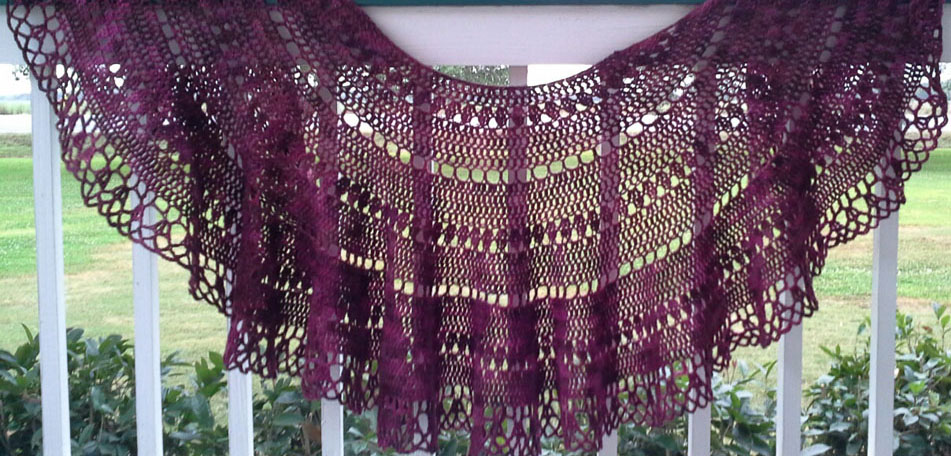
MonicaShawl

Monica’s Prayer Shawl

Do an online search for “prayer shawl ministry” and you will learn of two women who had attended and graduated from a Leadership Institude in Hartford, Connecticut in 1998.  They’d been in a program of applied Feminist Spirituality with Professor Miriam Therese Winter.  Professor Winter is a Roman Catholic nun (Medical Mission Sister) and an author and songwriter whose works are well worth exploring. These women, Janet Severi Bristow and Victoria Galo, combined compassion, prayer, and a love of fiber arts into a prayer ministry and spiritual practice. Their journey and ministry is described on the website, www.shawlministry.com.

Since then, prayer shawl patterns have been becoming more and more common.  Sure, it’s marketing, but I’m very glad to see this concept blossom in spite of the “secularization of America.”  Yarn manufacturers are designing simple patterns and actually calling them prayer shawl patterns.  Lion Brand Yarn(www.lionbrand.com) has a great assortment of knitted and crocheted prayer shawls.  Several books are available for crochet and knitted prayer shawls, and a “prayer shawl” search on the fiber lovers’ website www.ravelry.com yields (as of this writing) over 20,000 member projects tagged with the term “prayer shawl” or “prayershawl.”

What makes a prayer shawl a prayer shawl?  Intention.  Compassion.  Blessings, and of course, prayer.
The shawlmaker only needs basic crochet or knitting skills to do the work.  A shawl is begun with intention, with prayer and blessings for the recipient, and the shawlmaker may or may not know the recipient.  Shawls may be made with the intention that they will find the person who needs it most.  In other words, the Holy Spirit does the heavy lifting.  When the shawl is completed, the group (and anyone else who wants to join their prayers) may say a prayer for the recipient before sending it on its way.

Prayer shawls may be made for anyone – woman, man, girl or boy and they may be adapted according to the comfort of the recipient – a “prayer square” with a Cross (or Magen David) motif, or a small blanket  may be more appropriate for some than a shawl.  They may be made for someone going through medical treatment, for someone experiencing a loss, bereavement; a life-changing event (which can be joyous as well!), ordination…whatever!  A small cross or charm may be attached to the shawl, this is entirely optional.  Most ministries include a prayer with the shawl – and care instructions help, too!

No matter where you are with your craft, making a prayer shawl is a beautiful thing.  Your stitches don’t have to be perfect, just made with compassion and intention.  Remember that when you make a shawl (or blanket), you are, in a sense, joining the recipient on their journey one stitch at a time, one step at a time, one prayer at a time.