An Epiphany at Pentecost

I had an Epiphany on Pentecost.

My “ah-ha!” moment occurred during Fr. Matt’s sermon.  Now, I’ve heard many sermons on Pentecost.  They’ve all focused on things like the birth of the Church, the arrival of the Holy Spirit, the empowerment of the disciples and the like.

But Fr. Matt pointed out something I’d never considered before: Pentecost happened during a meeting.  

meeting-808754_1280 image from geralt on pixabay.com

Well, I about fell out of the loft chuckling.  A meeting! Known to so many of us as that great interrupter-of-productivity, that drainer-of-energy, that breaker-of-plans.  There’s not a soul on the planet who hasn’t, at one time or another, prayed for an excuse to avoid sitting in a meeting. Aw, shucks, I’ll have to miss the meeting, I have to bathe my cat / have a root canal / go to my niece’s dance recital.

It wasn’t just the meeting idea, though, that brought about my Epiphany.  It was the realization that yes, there IS power in group intention, and I’m seeing it coming out of the spiritual closet after hiding out for a while.

The apostles had been sequestered for some days after Jesus’ ascension, wondering what the heck was going to happen next.  They’d already seen incredible miracles.  But…what next?  They were hanging out in the upper room, praying, talking, eating, and yes, meeting.

mosaic-409427_1280 photo from music4life on pixabay.com

Paul, in Acts, tells us of the arrival of the Holy Spirit.  Call it a Hollywood moment or not, but clearly something happened.  Whether it was an arrival of God in the Holy Spirit, or whether it was an awakening of God / Spirit within is something I’ll leave up to theologians to quibble over.  But something stirred, woke up, brought, quickened, sparked SPIRIT inside of everyone there.

And I wonder what their shared intention had to do with it.  They were there, in community, together, all focused on receiving whatever direction they were to receive.  They were focused on surrender, to following whatever the path was.  I don’t doubt they were frightened and probably quite clueless.

What next?  And then, something happened.  Whether you call that something the Holy Ghost, Spirit, or whatever – something Divine that was greater than any one of them brought them all together in shared intention and empowered them.

Acts tells us that they went out among the people that very day, preaching and baptizing thousands.  Was it their shared experience – their meeting – that enabled them to lean upon each other spiritually, enhance the spiritual strength of the whole, and thereby be in a position to receive this incredible gift?

One way or another, consciousness rises.  Sooner or later, humanity realizes that God is indeed in each of us.  When we read the story of Pentecost, we should remember that this is what the story is about; that relying on Spirit – God – within ourselves gives us strength to do that which we would not otherwise do.  Joining with others to focus intention, prayer and awareness raises this consciousness as a whole.  I believe this is a path for humanity that we need to follow.  We are a wonderful collection of unique, individual souls with a glorious diversity of gifts and personalities.  At our core, we are all expressing God, for we are all made in the image and likeness of God from the very being of God.

The color of Pentecost is red.  This is the same color as the root chakra in Hindu and yogic traditions .  (If you’re not familiar with chakras, they are energy centers in the subtle body; a quick internet search will give you an overview.)  Each chakra is important.  The root chakra is one of energy and empowerment, and well suited to Pentecost.  For without the energy, empowerment, and passion of the Spirit that was awakened during that Pentecost meeting, the story of Jesus would never had made it out of the upper room.
Reentry

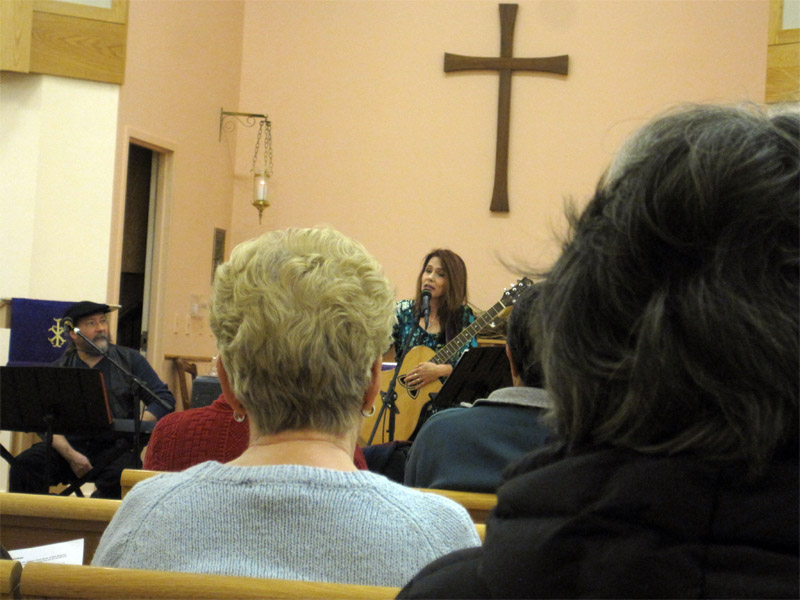
I’ve been absent from these blog pages lately.  My music partner and I returned recently from a week-long tour in Maryland, West Virginia and Pennsylvania, presenting our Women at the Well music program at several churches there.  It was a wonderful experience, and we were awed and humbled by the responses the music received.  What a blessing!  Then, home in time for the latter part of Holy Week, which meant more wonderful music in liturgy.

The tour was a stretch – it was a challenge to be in community with different congregations in so a short period of time.  You see, I don’t like thinking of myself as a “performer” in this context.  (Performing is what I do with the blues band!) I have no problem singing (or speaking) in front of people, but music focused on God is… focused on God!  I’m just the messenger, and I always hope that my technique enhances the music instead of taking away from it.

Yet, I know that not everyone feels comfortable being “in front.”  For me, it’s just a part of doing what I do.  The message is important, and I’m the one to deliver it, so…here goes.  I step up and sing and speak.

Transfiguration 1

And oh, how I long to know everyone in the room.  What are their stories?  I see individual faces, I get feelings, reactions from many…so I do know you.  Some are more guarded, some are wide open, some are in between.  Doesn’t matter to me.  I see the faces, I ride the ebb and flow, and I pray always that whatever is said and sung will bring comfort or joy or insight to someone.  It is, in my mind, a communal act – even though I won’t have the chance to meet everyone.  It doesn’t matter; we are all a part of this experience, in this moment, in this church.  And we are connected, now and into the future.

You are all part of Women at the Well, I say at the end of the event.  By being there, everyone has certainly given me a gift.  The Gift of Presence, of Witness, is awe-inspiring to me.  I tell everyone that they will be in our hearts.

And you are.

http://www.women-at-the-well.com

When in doubt…bring food.

Just a week ago I had a conversation with a couple of friends about “when in doubt, bring food.”  Whenever someone has a Major Life Event, the common response (at least in my corner of the world) is to bring a meal, a casserole, a….something edible and delicious.  I mentioned that I had often wondered if this “bring food” response is a Louisiana thing, or is more universal.  “I think it must be universal,” said I.  After all, drive-through daiquiri stands may be JUST LOUISIANA (yes, we have them) but food – well, everyone eats, right?  I was told stories by the other friends that indicated that this isn’t always the case.

Huh? This was a surprise.  If there were an official manual of Cajun Etiquette, page 1 would read simply this: When in doubt, bring food.

After all, it’s what we do.  When someone has a baby, bring food.  When someone has an operation, bring food.  When someone has a surprise, a shock, an unexpected visitor, an expected visitor (or a whole houseful of them), a new house, bring food. When you have a new neighbor, bring food.  When someone is packing to move out, bring food. And when someone dies, bring food. A meal, a covered dish, a casserole, a pot of gumbo…one brings food as a practical matter and as a symbol of sustenance.  It’s an act of nurturing, of caring and of sharing.

Bring Food

I made this for your family and mine; we don’t have to eat it together to know that we’re with you in this. We symbolically share a meal, and in a part of the world where cooking is practically a religion, the offering of a meal is sacramental: An act of grace, an expression of love. I can’t take away your burden, but I can make your life a bit easier.  I made you something that nourishes my family, I hope it nourishes and feeds your body and soul.  Have some comfort food.  Just receive; it was made with love and prayer.

If the event is a positive one, bringing food is still – always – an appropriate response.  A celebration? You’ll have company, and I know you’ll want to feed them and spend time visiting, you don’t need to be in the kitchen.  A new baby?  Rest, Mama, all y’all have to do is heat up the gumbo, and don’t forget to eat ‘cuz you have to feed that baby.  Your adult child is home from serving our country?  He or she needs some real home cooking, and you need to spend time listening, not cooking.  Eat.

Even if you are too numb to taste it, eat.  Your body needs fuel.  I thought of you and your loved ones; I prayed for you all while I chopped and cooked.  Whether prayers of supplication or prayers of thanksgiving, I thought of you as I decided what to make, selected the ingredients, and cooked.  My humble kitchen became a place of prayer as a meal for your family (and possibly mine, if the pot’s big enough) came together.

I made a lot, there’s plenty, don’t worry.  I’m not always good at saying what I feel, but I sure can cook how I feel.

Sometimes words fail us, but food doesn’t.  So when in doubt, bring food.

Prayer Shawls * 3 Dimensional Prayer

Thoughts at the beginning of a Shawl Ministry at the Episcopal Church of the Epiphany in New Iberia, La.

“Shawls … made for centuries universal and embracing, symbolic of an inclusive, unconditionally loving, God. They wrap, enfold, comfort, cover, give solace, mother, hug, shelter and beautify. Those who have received these shawls have been uplifted and affirmed, as if given wings to  fly above their troubles…”

                                  Written in 1998 by: Janet Severi Bristow    From the home page at:  http://www.shawlministry.com

prayershawl1

Wrapped in Prayer

I had a Zen teacher in college, Fr. Benjamin Wren, SJ, who taught – among other things – liturgical dance, ikebana and Tai Chi.  He called these “3 dimensional prayer.”  I thought of Fr. Wren when I started exploring the interest level for a shawl ministry at our church, because I also think of prayer shawls as “3 dimensional prayer.”

Shawls are practical, beautiful, nurturing.  Even though the idea of a prayer shawl ministry didn’t really burst into modern consciousness until 1998, shawls have been present in spiritual practice for a long time.  I think of the Jewish Talit, or fringed prayer shawl, worn at various times by Orthodox, Conservative and Reform Jews.  Our priests, deacons and bishops wear stoles when leading a service. Mantillas may still be worn by Spanish Roman Catholic women for worship (and were extremely common in French/Spanish south Louisiana in pre-Vatican II days). Pentecostal Churches may have “prayer cloths” – cloths that have been prayed over and in some cases, anointed.  All of these practices may serve to set the wearer apart, or to help the wearer indicate, even if only to oneself, that this time is now for prayer.

I can appreciate the concept of a prayer cloth.  Here’s something tangible that has been prayed over, given to someone to hold, to touch, a tactile reminder that someone else has been praying for them.  It’s a powerful thing to know that someone is praying for you, and having something in hand that underscores that can serve as a strong reminder: You are loved.  You are remembered and cared for by this community.  You are a child of God, our sister or brother in Christ, and this is a symbol of our ongoing prayer.

A shawl is this symbol, that wraps one in a comforting embrace.  So where did our 21st century concept of a prayer shawl ministry come from?

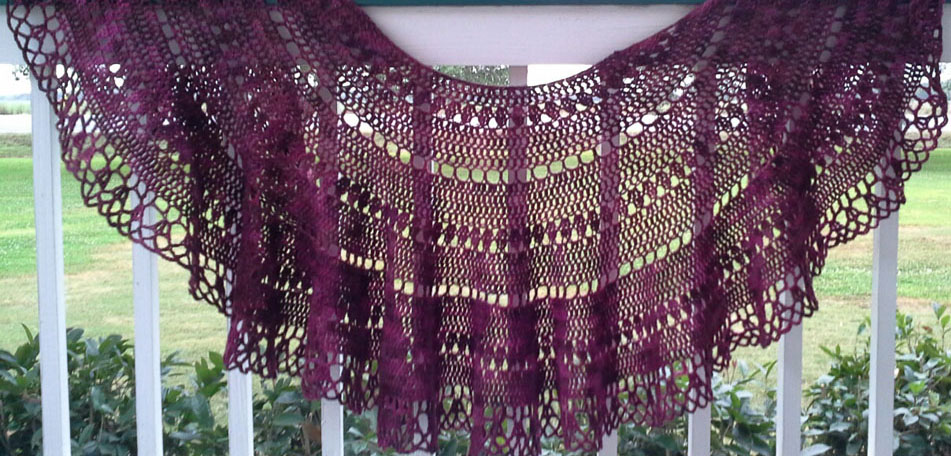
MonicaShawl

Monica’s Prayer Shawl

Do an online search for “prayer shawl ministry” and you will learn of two women who had attended and graduated from a Leadership Institude in Hartford, Connecticut in 1998.  They’d been in a program of applied Feminist Spirituality with Professor Miriam Therese Winter.  Professor Winter is a Roman Catholic nun (Medical Mission Sister) and an author and songwriter whose works are well worth exploring. These women, Janet Severi Bristow and Victoria Galo, combined compassion, prayer, and a love of fiber arts into a prayer ministry and spiritual practice. Their journey and ministry is described on the website, www.shawlministry.com.

Since then, prayer shawl patterns have been becoming more and more common.  Sure, it’s marketing, but I’m very glad to see this concept blossom in spite of the “secularization of America.”  Yarn manufacturers are designing simple patterns and actually calling them prayer shawl patterns.  Lion Brand Yarn(www.lionbrand.com) has a great assortment of knitted and crocheted prayer shawls.  Several books are available for crochet and knitted prayer shawls, and a “prayer shawl” search on the fiber lovers’ website www.ravelry.com yields (as of this writing) over 20,000 member projects tagged with the term “prayer shawl” or “prayershawl.”

What makes a prayer shawl a prayer shawl?  Intention.  Compassion.  Blessings, and of course, prayer.
The shawlmaker only needs basic crochet or knitting skills to do the work.  A shawl is begun with intention, with prayer and blessings for the recipient, and the shawlmaker may or may not know the recipient.  Shawls may be made with the intention that they will find the person who needs it most.  In other words, the Holy Spirit does the heavy lifting.  When the shawl is completed, the group (and anyone else who wants to join their prayers) may say a prayer for the recipient before sending it on its way.

Prayer shawls may be made for anyone – woman, man, girl or boy and they may be adapted according to the comfort of the recipient – a “prayer square” with a Cross (or Magen David) motif, or a small blanket  may be more appropriate for some than a shawl.  They may be made for someone going through medical treatment, for someone experiencing a loss, bereavement; a life-changing event (which can be joyous as well!), ordination…whatever!  A small cross or charm may be attached to the shawl, this is entirely optional.  Most ministries include a prayer with the shawl – and care instructions help, too!

No matter where you are with your craft, making a prayer shawl is a beautiful thing.  Your stitches don’t have to be perfect, just made with compassion and intention.  Remember that when you make a shawl (or blanket), you are, in a sense, joining the recipient on their journey one stitch at a time, one step at a time, one prayer at a time.