A String and a Prayer

A String and a Prayer is the title of a cool little book by Eleanor Wiley and Maggie Oman Shannon. I got it years ago during a period where I was having fun with beads. The book is about making – and using – prayer beads, and I was reminded of it as I recently brought home a set of prayer beads that really spoke to me.

Prayer beads have been around for a long, long time. Here in south Louisiana, prayer beads = Rosary. As someone who grew up Roman Catholic, I have several rosaries. I live not far from a place called “The Rosary House,” which carries what may well be the world’s largest selection of handmade rosaries. The folks who work there and make these rosaries are true artisans, and they view their job as a ministry. No matter what your faith, there’s a special energy in anything made by hand, particularly if it has some spiritual weight, so to speak. (Prayer shawls are sort of like that. And all of my prayer shawls come with a bit of my hair, and my dog’s as well. Extra mojo, you might say.)

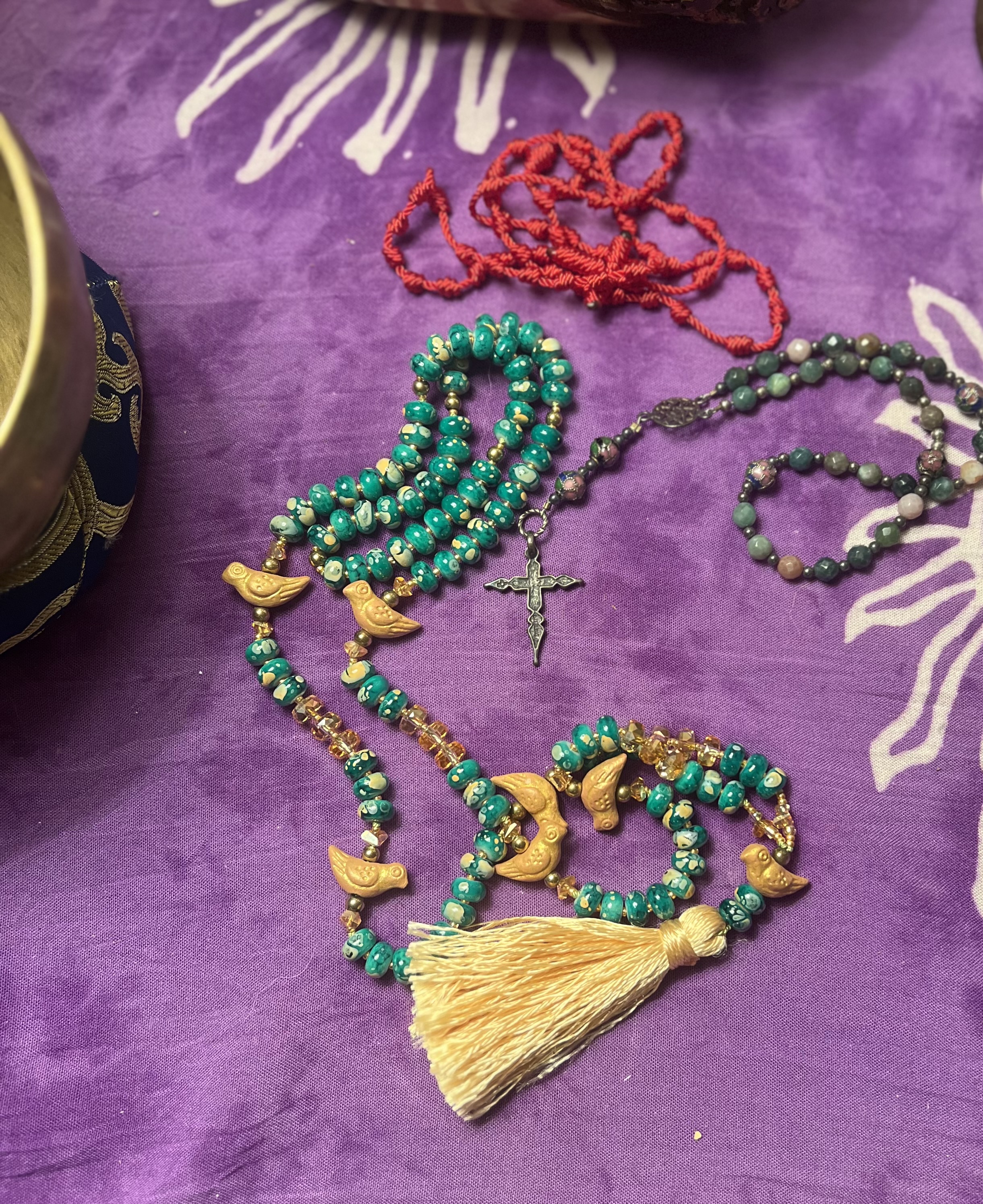
I was on a meditation retreat, and the bookstore had several mala bead sets. According to A String and a Prayer, “Most scholars believe that the use of prayer beads originated in ancient India with the Hindus…sandstone representations dating from 185 B. C. show people holding prayer beads…” The Hindu beads are called a mala and the strand traditionally has 108 beads. The set I took home is made of greens and golds, with bird-shaped accent beads. The tag read “when women were birds and knew all the songs.”

Clockwise from bottom: new beads “when women were birds and knew all the songs,” red handmade rosary, handmade Anglican prayer beads (made by the Community of St. Mary in Sewanee, TN and a gift from Deacon Diane Moore)

Well. How could I NOT get them, especially with a name like that? It also made me think…we all once knew all the songs, how did we forget them? How did we forget who we truly are, amazing souls enjoying an earthly journey?

I remember my grandmother (pop’s mom) spent her last years bedridden due to heart failure. It broke my heart to see her like that. I was in college at the time, and we lived a few hours away. While she was physically very weak, she was spiritually incredibly strong. Her eyesight was poor, so she couldn’t read or even watch television.

But – she prayed. Any requests we made, she prayed. She prayed my brother through law school, and me through college. She prayed for her family, and I suspect she prayed for patience and grace. Well, she received that in abundance. She was one of the greatest inspirations I’ve had, even though she left her earthly life several decades ago.

Anglican prayer beads aren’t like Catholic rosaries, and no, you don’t count off Hail Marys. I’ve used different prayers (or mantras) with them. The mala is used with mantras or with breath, but I’ve started doing something else with mine.

Each bead represents a person or thing or event in my life that I am thankful for. I name each person / thing, and no, it’s not written down (and it may change slightly each time). It’s amazingly easy to think of 108 (and more) people / things / situations / events that I am grateful for. Yes, I am blessed, and I am truly grateful.

I love it that we have three dimensional, tangible stuff that helps to keep us connected to Spirit. Hey, whatever works, right? Life can get crazy, stressful, hectic. Sometimes we’re so focused on surviving the day/traffic/AT&T headaches/someone’s meltdown that our Divine Connection can get a bit stressed. So…grab your prayer beads. Make a cup of tea (herbal if you’re stressed). Breathe. And say…thank you.

God-Stuff

We are powerfully creative.

And why shouldn’t we be? We are made of God-stuff.

In the beginning, was the Word. Our Creator spoke everything into being and began the cycles of life and creation that would bring forth each atom, each spec of being, each human soul.

What, exactly, are we made of? Whatever term you want to use for the Divine Creative Mind – God – had only Divine Self. Everything is made of God-stuff, and we are made in the image of that Creator.

We can be active co-creators of life and of our pocket of reality. We always are, whether we want to be or not. I hate hearing the media calling anyone “victims,” for it implies powerlessness.

While some circumstances are certainly beyond our control (sometimes feces occurs), our reaction to circumstances isn’t. Terrible circumstances can take time to overcome, and some cannot be overcome in this world.

Yet – we can decide how to face circumstances.

I remember when I worked as a Clinical Social Worker on the oncology floor of a hospital. I was asked to see a woman who had recently been diagnosed with cancer, and was refusing chemotherapy. My mission was not to “try to change her mind.” Rather, it was to provide another set of ears. Her oncologist and nurses had already discussed the clinical aspects of her decision. I was there to discuss the psychosocial aspects of her decision. Years later, I remember her resolve – and her peace.

She didn’t have an attitude of “poor me.” Rather, she was peaceful, and felt that her quality of life was of primary importance to her and her family. She was also a woman of faith, and knew that life continued beyond the physical.

Her choice wasn’t to lie down and die; it was to live fully for as long as she could. Contrary to what some might say, she didn’t just let life wash over her. She knew that sooner or later, things would get better, and reminded herself of it constantly.

When we were faced with something painful, mom would remind us that “this, too, shall pass.” I remind myself that “things are getting better” because eventually – they do, even though our brains may scream in revolt at times. Working on this mindset also puts us in a mindset of gratitude.

Magically, things eventually do turn around. We recognize the blessings that we do have, focus more on them, and find other things for which to be grateful. Things get better.

Why? Because you, dear reader, are infinitely creative, and made of the same stuff that God is made of.

Image: Solar eclipse, August, 2017 © B. D. Lowry

Merry Christmas!

Merry Christmas? But…it’s January 4!

Yep! And we’re still in the Christmas season. Epiphany isn’t until Monday, and my decorations are still up. It won’t take long to take them down, as I’ve simplified things over the years, but they probably won’t go back into the boxes until next weekend.

It was a nice Christmas, all things considered. The last few years were pretty lousy – three years ago, pop died. Two years ago, I broke my ankle and spent Christmas recovering from surgery (I won’t say it was “shattered” as my very talented orthopedic surgeon managed to find all the pieces of bone and reassemble them with some heavy-duty hardware), and last year my best friend and music partner died suddenly right before Christmas. This year, we lost mom – which should have made it another crappy Christmas.

But oddly – it wasn’t. Maybe it was because we all breathed a collective sigh of relief that she and pop were together again. Maybe it was because she wasn’t suffering any more. Maybe it was because we all realized that, as hard as it was, it could have been a lot worse.

And maybe – just maybe – this Christmas was a gift from the Holy Spirit.

Sure, we got a little weepy. We missed some people terribly. Mom had left some instructions for some personal gifts, which were given out. I’d like to think that mom was able to see everyone’s reactions. I do know I felt her presence – and pop’s, and Bubba’s – very strongly. Does it take the place of their being there “in the flesh?” Of course not. But because of Christmas – and Easter – we know we will be with them again. We know they are wrapped in love and peace.

And of course, there were some laughs: My brother continued the tradition of the rubber chickens. Once again, his ceiling (and it’s a tall one) is covered with little rubber chickens. It started a few years ago when he ordered a pack of small rubber chickens (you shoot them like rubber bands) from “slamazon” (as my friend Cathy J calls that big online retailer), intending for us to shoot them at one another like the overgrown kids we all are.

I’m pretty sure it was Bubba who first aimed a chicken at the ceiling. Or maybe Harris. Hey! They stick! And so a new holiday tradition was born.

Can you hear it? “Oh, we love to decorate the tree as a family on Christmas eve after we go to church, and then after Christmas dinner we go caroling! What do you do, Brenda?” “Oh, we crank up the air conditioning, build a fire in the fireplace, drink champagne and shoot rubber chickens at each other and at the ceiling.” Yep, that’s my family.

And among all of this craziness is family, love, and the peace of the Holy Spirit. I realize a lot of people struggle with Christmas. I have for years – so did mom; she said that she was reminded of all those she loved who had left this life. I do think she had a better Christmas this year, as did pop, Bubba, and all of our loved ones on the other side. #84 in the Hymnal 1982 sums it up beautifully:

May the peace of the Holy Spirit and the gift of the Incarnation be with you throughout the year. And don’t be afraid to say it: Merry Christmas!

First Christmas without….

There are many articles out there for dealing with grief during the holidays, as the holiday season is traditionally a season spent with family, loved ones, friends, and – well, tradition.  Everybody knows it’s tough facing Christmas or Thanksgiving without a loved one. This year has special meaning for me, as it will be our first Christmas ever without Pop. Sadly, I could name quite a few others who are going to experience their first Christmas without…. Someone they love.

I’ve found myself thinking back to the years I spent working as a Social Worker (LCSW – I keep my license current, though am not in full time practice) and things I learned from patients. (I worked mostly in oncology.)  I’ll share some inspiration I learned from those grieving (and a few ideas of my own):

~  Take the word “should” right out of your vocabulary. And don’t feel guilty about it.

~  Change things up. (If you don’t like turkey, maybe this is your chance!) In south Louisiana, food is sacred and this might be the year to switch to pork roast or turducken or brisket. What, you don’t know who’s going to make the rice dressing now that MawMaw isn’t here? Gather family members and learn how to cook it together. I remember a family who couldn’t imagine Christmas without MawMaw because she always cooked. It was an opportunity for them to gather at MawMaw’s kitchen and cook together (they’d been banished from her kitchen before as she insisted on doing everything).

~ Make a donation in honor of your loved one. If you find yourself teary-eyed while shopping and thinking how much “they” would like something, donate the money you would have spent to a worthy cause. Or be a “secret Santa” for a community or church giving tree.

~ If you can’t face a holiday dinner, consider volunteering at a local food bank or community kitchen.

~ If you do have the holiday dinner, remember your loved one and drink a toast to them. Have a slice of their favorite pie for them. They aren’t gone, they’re just quiet, in another room (and it’s a much nicer room that we can’t see on this earth).

~ Gratitude goes a long way. Find things to be grateful for, and start with the life of that loved one.

~ Cherish the memories, and cry when you feel like it.

~ Worship, whether with a community, with family, or just alone if you can’t face a crowd.

~  Remember that everyone grieves differently, in their own way, in their own time.

~Above all, try to focus on the hope of this season. Each year at Christmas, we are reminded that in spite of the fact that humanity is broken, sinful, and generally messed up, God still gave us the gift of his son Jesus. No matter what trials befall in this life, we have the promise of redemption. The miracle of the Incarnation is indeed a miracle; God didn’t have to do any of this. But what better way to show Divine Love than to take on human form, walk among us, and show in unmistakable ways how much we are loved?

We know this world is upside down, and the loss of a loved one only makes the feeling heavier.  We felt Pop’s absence at Thanksgiving, and will feel it even more sharply at Christmas. But I’ve been looking at photos of him from last Christmas and grinning.  I’ve been remembering being a child, waking him and mom up at 5 AM saying look what Santa brought and chuckling over his and mom’s bleary-eyed excitement for my brother and me. We had him for decades, and no amount of grief can ever take away my gratitude for having him as my father.

May God bless you and yours this beautiful Christmas season.

A Holiday of Faith

Yesterday we had a conversation in the choir loft about secular vs. religious holidays. While not a religious holiday, Memorial Day is a day of faith, and yes, a sacred one that should transcend all faith traditions.

We in the USA mark the last Monday of May as a day to honor and remember those who gave the gift and sacrifice of their lives in their service in the armed forces of the country. Sounds secular, right?

One of our most basic recognized rights in this country is the freedom to worship freely. While we take this for granted, we don’t often stop to think how rare this was in 1791 when it was included in the Bill of Rights.

Without the sacrifice of those we remember today, there’s a good chance we would not have been allowed to worship as we please.

As it is, church attendance has dropped to an all-time low, perhaps in part because of the avoidance of government to support religion in any way. When I was growing up, heaven forbid that any school would host a sports tournament that included play on Sunday morning. This is no longer the case.

Whatever you think of the reasoning for certain wars in our history, never forget that each individual who took an oath in the armed services agreed to pay whatever price was asked by our nation, including the cost of their lives. 

I don’t know who said this, but it’s worth repeating:

(This may be said of some of soldiers of certain other countries as well, but right now I’m talking about our own Memorial Day)

Today, please take time to remember and give thanks for the sacrifices of those who gave their lives so that we may worship as we please and live in freedom.

Thanksgiving

Today is Thanksgiving, and – dare I say it – a very American holiday. We’ve seen decorations of pilgrims and pumpkins, corn and horns of plenty. We’re used to our holidays being commercialized, and today is particularly a good day to reflect on what, exactly, this holiday means and how it began.

In 1789 (over a hundred years after “the first Thanksgiving”), George Washington issued a Thanksgiving Proclamation. I think it is particularly important to consider this document, as we are inundated in the media by claims that “God had nothing to do with the founding of America.” A recent “man in the street” video piece by The College Fix asked students whether or not it was acceptable to celebrate Thanksgiving.

“ooo. I’m leaning towards no. I feel like with, you know, the historical context, the, kind of, you know, the really awful oppression of, you know, indigenous peoples, is like the holiday is really like, praised by I think, people more like the conservative side of things, to like uphold that sort of tradition…”

“Well, the entire thing is sort of based on indigenous peoples, and [shrugs] murders of indigenous peoples”

“Ummm, no. I mean, it’s probably not as bad as Christmas or Easter…”

The reporter was at a small Christian private college in Minnesota. Are you freaking out yet? I am, and not just because of the fact that these students obviously need to take Speech 101 and remedial English. Some of the students even admit that their “standard public school education” Thanksgiving story was this great meeting between the pilgrims and the Indians where “the Indians showed ‘em how to plant corn, and obviously that’s not true.”

I’ll leave it to you to draw your own conclusions. I doubt that they learned about George Washington’s Thanksgiving Proclamation, issued 3 October 1789:

GWashThanksgiving

“Whereas it is the duty of all Nations to acknowledge the providence of Almighty God, to obey his will, to be grateful for his benefits, and humbly to implore his protection and favor —and whereas both Houses of Congress have by their joint Committee requested me “to recommend to the People of the United States a day of public thanksgiving and prayer to be observed by acknowledging with grateful hearts the many signal favors of Almighty God especially by affording them an opportunity peaceably to establish a form of government for their safety and happiness.”

The Proclamation goes on to specify the date of the holiday, and then that the day “be devoted by the People of these States to the service of that great and glorious Being, who is the beneficent Author of all the good that was, that is, or that will be…”

Washington’s proclamation came a little more than a hundred years after the arrival of the Mayflower. He was closer to that history than we are, and no doubt was aware of the dreadful first winter the Pilgrims endured. He would also have been aware of the history of the native tribes that played a role in the lives of these early settlers and the warring between them. The Wampanoag did work with the settlers, and were no doubt glad to have help in their own struggles with the Iroquois (who were warring with the Wampanoag and others).

The_Mayflower_Compact_1620_cph.3g07155

The Mayflower Compact by Jean Leon Gerome Ferris

The travelers had set up an agreement based on Biblical principles that would establish how they lived and worked when they settled in the New World. Laws were established that would apply to everyone, regardless of political or religious beliefs, and all property would be community property. Basically, “from each according to his ability, and to each according to his needs.” Sound familiar?

Well, after a dreadful, difficult voyage over, they settled in and got to work. And you know what happened? Their setup didn’t work. They had created this “group venture” so as to be able to repay their sponsors back in England, but it was failing, because there really wasn’t any personal responsibility.

And…this was happening with a group of Christians who believed in sharing and caring for one another. It wasn’t a bunch of criminals or shysters; if any group could have made such a socialistic setup work, it was this bunch. Fortunately for us, John Bradford, the colony’s governor, realized it wasn’t working. Instead of beating a dead horse (possibly not a metaphoric saying in this instance), he started over. Each family received a plot of land, and was able to use it as they saw fit. If they had surplus, they could sell it. If they didn’t have enough, they could buy what they needed. They had a basic capitalistic society, and it worked.

To be sure, the Wampanoag had pitched in to help them survive their first winter, and had a good relationship with the colony. But it was more than just their assistance that helped the settlers at Plymouth survive and build a colony. Religious freedom and the right to work and make one’s own success also had a lot to do with it.

For anyone disturbed by the “Americanism” of the holiday, I will remind you that while Washington himself had the good of America as his primary concern, he didn’t close out the rest of the world as he encouraged prayer to God:

“…to protect and guide all Sovereigns and Nations (especially such as have shewn kindness unto us) and to bless them with good government, peace, and concord—To promote the knowledge and practice of true religion and virtue, and the encrease of science among them and us—and generally to grant unto all Mankind such a degree of temporal prosperity as he alone knows to be best.”

Amen to that. I wish you a happy Thanksgiving.

To read George Washington’s Thanksgiving Proclamation:

https://founders.archives.gov/documents/Washington/05-04-02-0091

Life on the farm…

My brother jokes about that line from the old John Denver song,  Thank God I’m a Country Boy.  While I agree with that (Girl, in my case), I’m not so sure about this part:

Well, life on the farm is kinda laid back….

Hm. Sometimes, but not usually.

Friday afternoon I walked down the driveway to collect the mail. What greeted me but this scene:dead box

I let loose several choice (French) exclamations. Post…still standing. Mailbox…in the ditch. (The mail, fortunately, was still in it.)This wasn’t the work of a baseball bat, but a car – someone wasn’t paying attention and took out our mailbox, as well as his or her rearview mirror, which was found nearby.

Now, we had a few baseball bats when we first moved here (for me, it was moving back here), but quickly solved that problem with a little Cajun Engineering.

inside new boxTwo different sizes of mailboxes, one sunk inside the other with an insulation of cement. On a 4 x 4, sunk in more concrete. That put an end to joyriders with baseball bats. Can’t y’all respect other people’s property? And isn’t destroying mailboxes against some federal regulation?

Our rural Postal Carrier, bless her, brought the mail to my door on Saturday and asked about the box. Her eyes grew big when I told her what happened. She just shook her head and said “get off the phone and drive, huh?”

Even though the baseball bats have stopped, this is the third – or is it the fourth – cement-reinforced mailbox we’ve put up. Every few years, some drunk couillion takes the curve too fast and winds up in the yard or the ditch. Occasionally they take a mailbox with them. Although the curve is very well marked and drivers are given plenty of warning, there’s always that special someone who just doesn’t pay attention.

Like the guy who recently flipped his F150 pickup and landed on the top of a cane tractor across the road. A sheriff’s deputy knocked on the door and very politely asked if we knew anything about what had happened. Seems that the driver took off after the accident. I’d actually seen the truck earlier, but it was perched so perfectly I didn’t realize that it wasn’t quite intentional (you really never know around here).

Another time someone put their jeep through my cousin’s fence. He, too, took off. I don’t know if the penalty is stiffer for leaving the scene of an accident or for a DWI, but I’m sure those drivers found out.

It’s never dull in the country. And it’s not exactly laid back, either. A couple of months ago, David asked “did you see the alligator in the pond?”

My response:  “Another one?!?!”

Petey the Pond Gator stuck around long enough to be named, but took off eventually. Probably a good thing.

gatorThere’s always work to be done here, but pleasures and rewards are many. I walk to work in the morning to the song of birds and the view of the pond (with or without gator), with occasional egrets, blue herons or ducks (and even a pelican) dropping by.

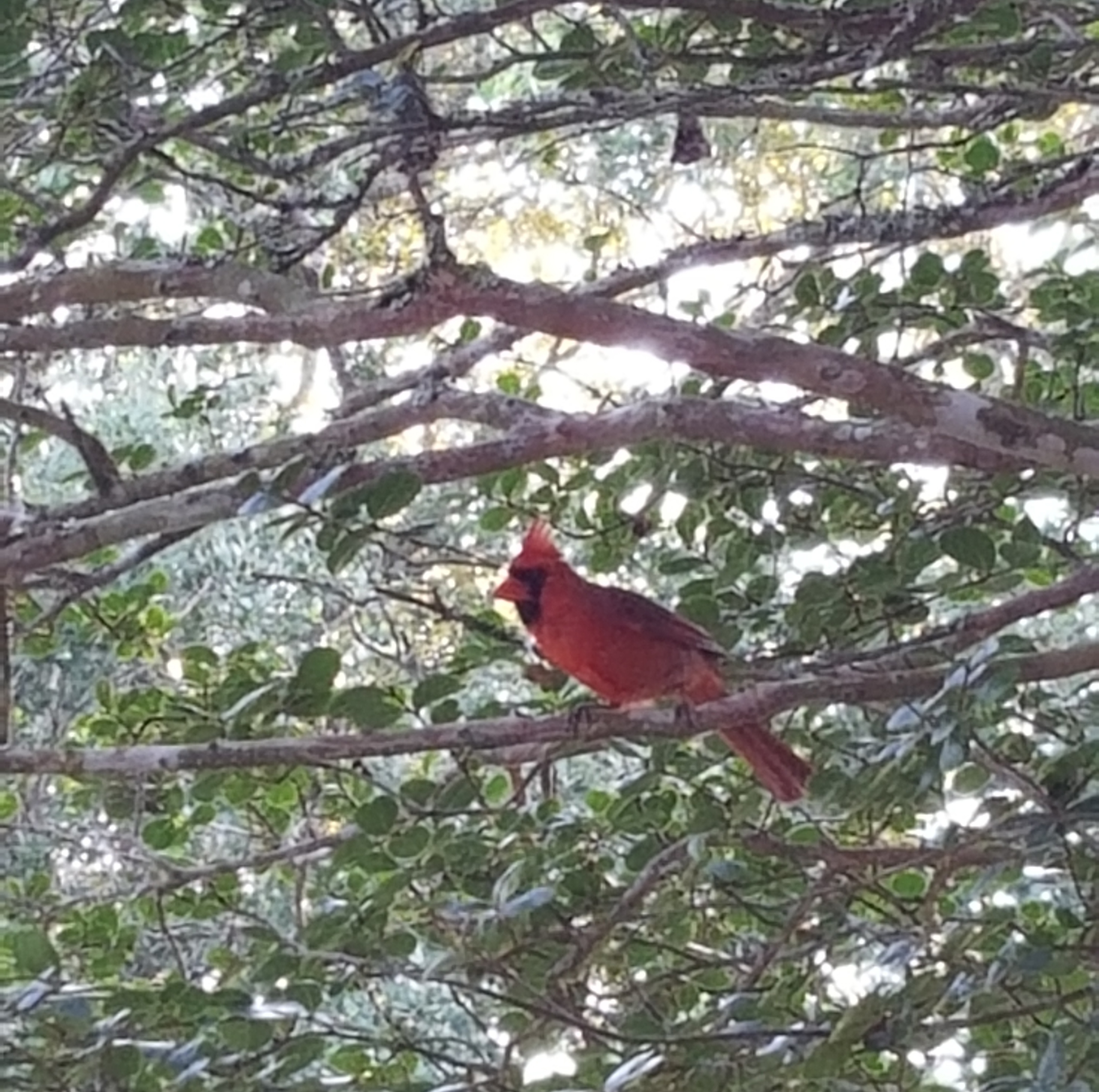
CardinalThese are precious sights that keep me grounded and make me laugh about things like the gator and the mailbox.

sunsetflying

Life ain’t nothin’ but a funny, funny riddle….thank God I’m a country girl.

On the 12th day of Christmas…

When asking someone “how was your Christmas?” we often receive a reply along the lines of “it was lovely! And I’m so glad it’s over!” I heard that just this morning, and on this, the 12th day of Christmas, I was reminded of something I read recently on Twitter.

It was a retweet of something posted by @theodramatist: “What are some ways that we can start reclaiming/celebrating ALL 12 days of Christmastide?”

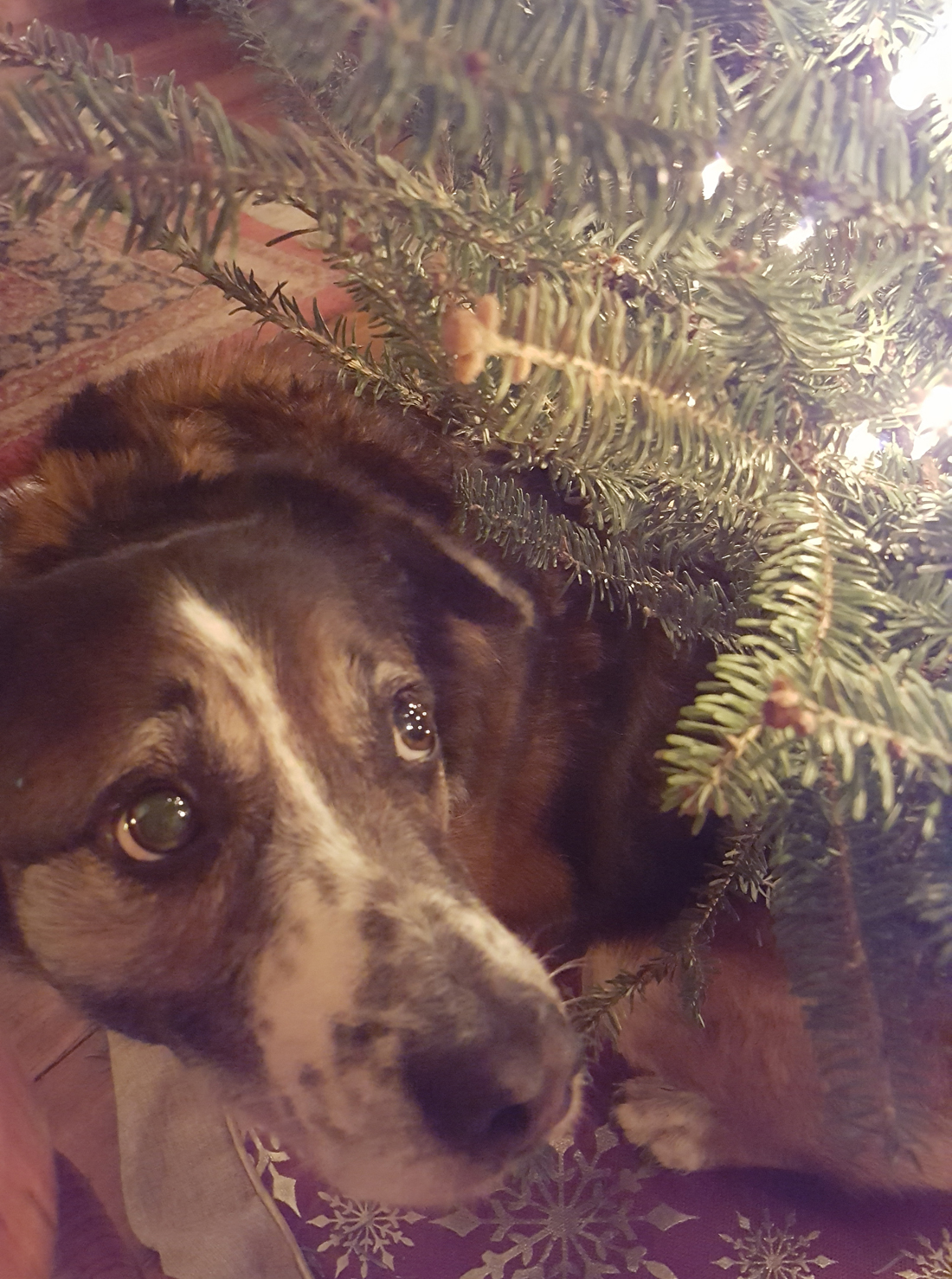
nativity dog

How can we keep the magic of Christmas?

Responses to this tweet included ideas old and new, and some great ones at that. While the Christmas theme continues in church until Epiphany, the secular world has mostly moved on. Retailers put Christmas stock on sale Dec. 26th, and – for the most part – wishes of “Merry Christmas” or “Happy Holidays” has become “Happy New Year!”

Christian churches do, of course, stick to the liturgical calendar. And while I understand that Christmas is a busy and exhausting time for staff, how about keepin’ it “high church” for a while if that fits your congregation? (Um, incense is optional.) I had a crazy idea of a midweek carol sing – a week after Christmas. (Why not? Everyone finally has time for it!)

nativity 2

A Nativity scene made from cypress knees on display at Epiphany Church, New Iberia (2018)

In recent years, my church has started doing the children’s Christmas pageant as an Epiphany pageant, which I think is a great idea. My own home decorations stay up until Epiphany. Here in the the sugar country of south Louisiana, families whose lives follow the calendar of grinding often find alternative dates to celebrate when grinding isn’t finished by Christmas (often the case).

But the feeling of relief that “Christmas is over until next year – WHEW!” is a little sad and bittersweet.

To be sure, Christmas IS a sad time for many, filled with bittersweet moments for nearly all of us. We are reminded of loved ones who are no longer with us; we are reminded of the changes in our lives and the lives of those around us. We look at the changes in the world, and (human nature being what it is), we focus on the things we lack and the things we miss while often glossing over the positive changes.

nativity 4

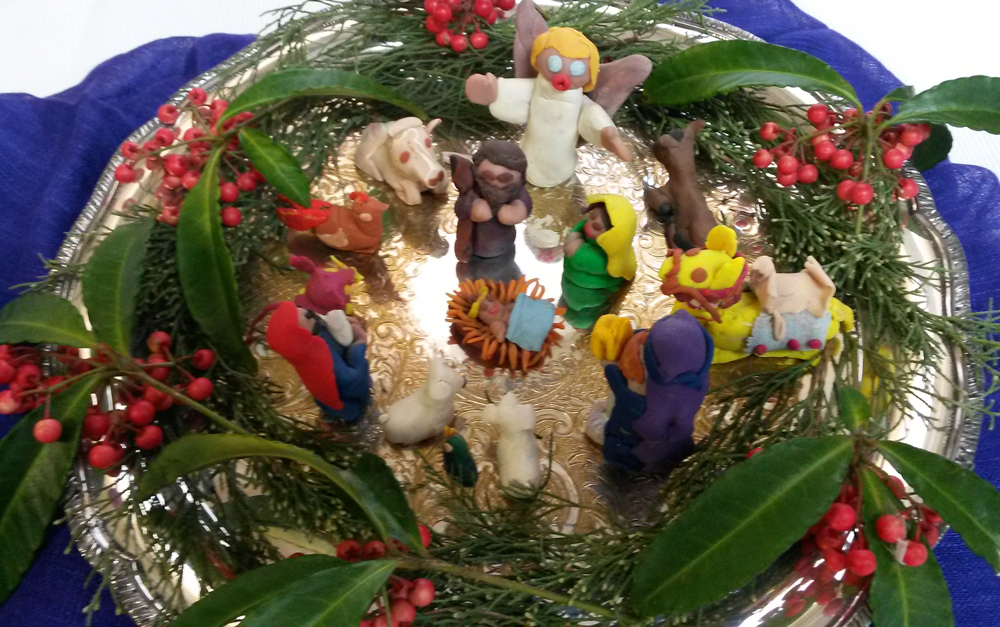
a handmade clay Nativity displayed at Epiphany last year

Even the wonderful things about the Christmas season (time with loved ones, community worship, giving) tend to overwhelm us, and I think it’s because we try to squeeze it all into such a short period of time!

Shouldn’t that be a good reason to remind ourselves that yes, there are twelve days of Christmastide, and we all pretty much get started celebrating Christmas during Advent anyway. So why all the stress?

Maybe it’s because we want to ignore the things that hurt us, the painful memories, and the wondering-what-next-year-will-hold. The sad irony is that the very gift of Christmas, the miracle of the Incarnation, should be the healing salve that tends the wounds of the less-than-Hallmark-perfect holiday – and so often we forget about that miracle.

nativity 1

One of the many Nativity scenes displayed at Epiphany church on our feast day

I’ll be packing up my Christmas decorations today and tomorrow, with the exception of the Nativity. (After all, the wise men don’t arrive until tomorrow, anyway.) As I do so, I’ll be revisiting the memories of Christmas past and be grateful for them. I’ll challenge myself to bring the beauty and miracle of the Incarnation into all of 2019. Tomorrow, I’ll watch our Epiphany Christmas Pageant, sing Christmas carols, and enjoy the first king cake of the season – and maybe find a plastic baby Jesus inside the cake.

I’m welcoming baby Jesus into my heart, and hope that you do, too.

Merry Christmas, and God bless us everyone.

How Can I Keep From Singing?

Submitted to the DAR Women’s Issues Essay Competition. It received state honors (Louisiana). OK, Charlotte, here it is. 

I suppose I’ve come to that “wise woman” part of my life, even though I don’t feel wise. I am a wife, mother, office manager for my family business, songwriter, and vocalist. I am occasionally asked for advice by young singers.

I tell them that a vocalist can never replace their instrument. If it gets damaged or broken, we can no longer sing – or we must find a way to deal with the damage.

sing 1

This is the story of my own damaged instrument. Not my voice, but my ear. My advice to young vocalists has expanded to include: If you ever experience sudden hearing loss, it is a medical emergency.  I tell them about the symptoms of Meniere’s Disease.

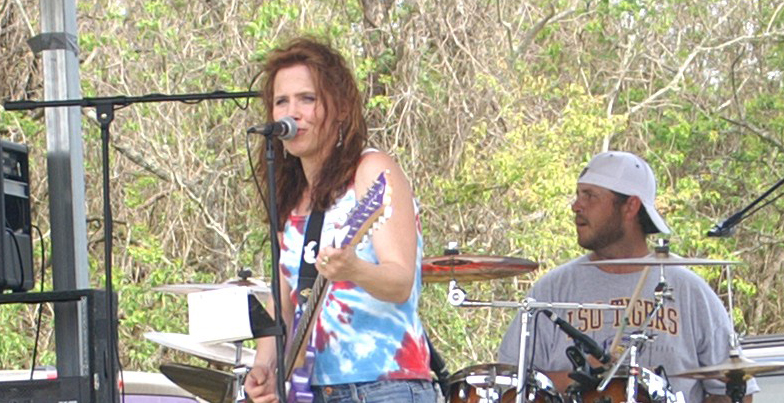
I juggled singing with job and family life. I sang with my blues band, at my church, at our local Jewish temple, and with my music partner in our Gospel duo. God makes each of us an instrument, and I did my best to learn to use and care for my musical instrument. Call me “Queen of the Earplugs;” I treasure my ears.
sing 2

Earplugs don’t help with allergies, though. For years, I’d have occasional bouts of clogged ears and dizziness during high allergy seasons. One December day a few years ago, my ears clogged.

I thought it was allergies, or possibly I’d caught my husband and daughter’s virus. I had things to do at the office and two sick ones to care for. I knew what this was, took ibuprofen and antihistamines, but it got worse.

I couldn’t hear anything clearly in my left ear. While it had been several years since my last “spell,” I’d had a severe dizzy day recently, so I saw my ENT, who was familiar with my history. I expected the usual cortisone pack, but this time he looked at me with concern when I told him this had lingered for three weeks.

I knew from his expression that something was different this time. This should have run its course by now, he said. He prescribed cortisone and an antifungal.

“When will my hearing return?” I asked.

“Let’s wait and see what the medication does,” he replied.

I took what felt like a never-ending course of cortisone and Valtrex.

After a month of medication, Dr. Robert ordered an MRI. Fortunately, there was no tumor, but no answers either. I went to the audiologist for a baseline audiogram. There was nothing but noise and pain in my left ear. Results? My right ear was good, but my left ear showed a profound hearing loss. I took a copy of the report home, filed it away, and cried. I cried me a river, as the song says. How ironic.

sing 3

I told only family and closest friends. I quit scheduling band gigs; even with earplugs jammed into my ears, I was afraid to take any chances. Meanwhile, a bizarre group of sounds had moved in where my hearing used to be: Tinnitus. In different keys. All at once.

Dr. Robert had told me that we needed to wait a year, as there was a chance that my hearing would return with time. Meanwhile, I had this invisible, sudden, crippling loss that I couldn’t even talk about or escape. After asking my husband to repeat something for the third time one evening, he voiced his frustration. “Are you DEAF?” he cried.

I fell apart.

“YES, I AM.” I replied. “In one ear. Half of everything I hear is GONE.” He felt terrible. So did I.

I began telling a few people about my loss. I was shocked at some of the responses.

“Well, I guess so, all that loud music you play!” A laugh. “I could have told you THAT was going to happen!”

Really? I’m the one wearing earplugs, remember? I have the small band that is known to be considerate of noise levels.

My response was anger. Then, there was the well-meaning advice about earwax, about this doctor, that diet, this treatment, etc. No, a cochlear implant would only destroy the way I hear music.

That year was one of adjustment, resignation, and hope. In many ways, I had to relearn to sing because I had to learn how to hear again. Our brains are wired for stereo, and that was lost to me. I quit going places where a large group of people gathered because I could no longer discern voices in a conversation. I quit going to movies and concerts and any live presentation because they were hard to follow. Everything was a wash of noise, coated with a blanket of anxiety and occasional panic.

I considered hearing aids, although I had no idea how to pay for them. We had two children in college. This was hope, though: One day, I can get hearing aids. 

I longed to hear in stereo. I wanted the safety of knowing where a sound originated. If someone called my name, I had no idea of where to turn. I don’t know where a siren or horn is coming from in traffic.

I wanted to hear music in stereo.

When the year was up, I went back to Dr. Robert and the audiologist. I was hopeful, as Erica, the audiologist, had successfully fit my father with hearing aids. I was determined to put up with whatever adjustment was needed. Surely no hearing aid noise could be more obnoxious than tinnitus!

The testing was similar to a routine audiogram. Erica explained that the noise and sounds and speech I would hear in the headphones would be adjusted just as it would be with a hearing aid, so we would find out whether or not a hearing aid would help me.

Whether or not? I hadn’t realized there was a chance that this wouldn’t work.

Today’s hearing aid technology is phenomenal. From what I knew about audio engineering, the ability to adjust amplification of specific frequencies in a device so tiny was nothing short of a miracle.

Unfortunately, this miracle was not to be mine. No amount of amplification or adjustment made a difference – only physical pain. I sat in Erica’s office and sobbed as she held my hands and offered tissue, understanding, and honesty. The cilia, the microscopic hairs of the inner ear that enable us to hear, were dead. No diet, supplement, medication, procedure or technical device would restore them. I faced a life in monaural, but at least I had one functioning ear.

She also offered a tentative diagnosis: Meniere’s Disease. My decades-long history of periodic dizziness was a clue. I’d had several particularly violent dizzy periods in months preceding the hearing loss. During the worst dizzy periods, I always spun to the left. I had become so used to a dizzy period during high-allergy months that they just became a part of life, diagnosed previously as “Benign Peripheral Vertigo.”

I learned about Meniere’s Disease, and saw my history written in what I found. Dr. Robert’s suggestions to address the vertigo were basically the same as for Meniere’s, but I felt defeated as I learned that no one knows the cause of the illness, and there is no cure. My years of periodic spells, interspersed by periods of feeling normal, had a name. Interestingly, it affects more women than men, and the possible causes include infection, allergies, head injury, stress, fatigue, migraines, respiratory infection, and an autoimmune response. I wasn’t too surprised that women experience Meniere’s more than men. It usually affects one ear, but sometimes attacks both over time. I cannot dwell on that. It is critical for me to maintain my balance, and I mean that metaphorically as well as literally.

balance

Balance.

It’s not always obvious that I have a hearing deficit, but an astute observer will notice. I’m getting better at lip-reading. In music, I seek the right position to hear what I need to hear in order to sing. In any group seating situations, I tell the person on my left “I’m deaf in this ear. If you say something and I don’t respond, it’s because I didn’t hear you.” I’ve learned to deflect the still-painful topic of hearing aids by saying “it’s a sensorineural hearing loss, which cannot be fixed by a hearing aid.” I’ve learned that such queries are usually out of concern.

I also tell others that sudden hearing loss is a medical emergency, even if you’ve had it before and you think “oh, allergies.” I also tell them about Meniere’s Disease.

On the positive side, the dizzy spells have mostly stopped; this, too, is typical of Meniere’s. As for singing, I’ve had to hyper-focus my sense of pitch, which has strengthened my vocals. I’ve heard of other vocalists who have experienced a similar hearing loss who have quit singing.

I can’t not sing. I have found a new way of listening, and a new way to focus on the experience of singing. It is a whole-body expression, as you must feel the vibrations and melody in your body. Your mind, throat, ear, mouth, lungs must know how the notes feel as well as how they sound. Perhaps it’s similar to the heightened sense of hearing that some vision impaired people have; I am partially deaf, so I have an enhanced sense of certain facets of singing that some take for granted.

Cedartown680

How can I keep from singing? At a Women at the Well concert. Photo by Rev. Kemper Anderson, at St. James Church in Cedartown, Ga.

About three years into this journey, my music partner and I were preparing to go on a short tour of several churches in the mid-Atlantic states, performing our original Gospel program about Jesus’ women disciples. We had recorded several of the songs from the program, and I longed to re-record some vocals and add harmonies.

Singing overdub harmonies is a challenge when you have only one functional ear. I managed by notating the harmonies, placing the headphone behind my one good ear, and forging ahead in spite of fear deep in my soul. What if I couldn’t do it?

But I could, and I did. A few days later, after the vocals were mixed, we shared the tracks with a friend. Danny is a gifted pianist who tours worldwide and has done a lot of recording and harmony vocals. He knows of my hearing loss, and was floored when he heard the harmonies.

“That’s a miracle,” he said, “that you could do that.”

It is a miracle, and one for which I am profoundly grateful. I still ache over the loss, but on the other hand, I now sing more sacred music and chant. Sometimes frustration still rises to the surface. That’s when the words and music of the hymn How Can I Keep From Singing sustain me:

Through all the tumult and the strife, I hear the music ringing

            It finds an echo in my soul. How can I keep from singing?                      
Too much.

Two highly visible suicides this week bring that subject into the forefront for the time being. For survivors (family and friends left behind), suicide will always be with them. For those who live with depression, thoughts of suicide are often there.

For the rest of the world, well, we’d just rather not think about it, right?

I’m not practicing professionally right now (I’m a Licensed Clinical Social Worker), but keep my license current and never stop learning. Suicide prevention is a subject that people will ask me about, and I know in at least some instances they ask me because I’m NOT currently “working in the system.” So I urge them: If someone has verbalized thoughts of suicide, take it seriously.

How often have you heard “I just can’t see how someone can do that?” When someone takes their own life, they’re not thinking right. It’s not a rational act, no matter how much the Suicide may rationalize it. “I have no way out.” There is always a way out, a way through that doesn’t entail leaving this world.

Remember, that person is in a dark, dark place. If you can’t see how someone can do that, you don’t understand the darkness. Be glad you’ve never been there. And if you ever find yourself there, I pray you’ll hang on to a glimmer of hope that things can get better, and seek help.

Hope – and help – is always on the horizon.

If you’re one who believes that suicides are eternally damned, I ask you to reconsider your view of (and relationship with) the Divine. I recognize that this is a long held belief in many branches of Christianity, that suicide is “the unforgivable sin.”

That’s just bull. The God I know isn’t like that. The God I know can – and will – forgive anyone! Is the soul’s journey over at the end of human life? Of course it isn’t. The body’s life is done, and so are the physical limitations of the body. I believe one can ask forgiveness even free from the earthly body. I don’t believe that God says “too late, had your chance, muffed it” and zaps the soul into eternal hellfire.

Besides, deep depression has a physiological component. I’ve heard news-chatter over the past few days that “more people are taking antidepressants than ever, but we have more suicides than ever, so…they’re not working?” That’s a pretty simplistic way of looking at things. There is a great sense of despair, confusion, and uncertainty in the world – and we’ve become a more secular society (to the point of forcing God out of everything as much as possible).  Hmmm, could the two be connected? The almost total elimination of the Divine from our public life is a far cry from “Congress shall make no law respecting an establishment of religion, or prohibiting the free exercise thereof.…” We don’t have a state religion, but God has been shoved aside in public life because heaven forbid we should bring, um, heaven into the discussion!!

beauty 2

Take time.

The explosion of antidepressant use has many reasons, and I think that one reason is that it’s no longer as much of a stigma to seek help for depression. Another is that we live in a sea of stress. Fr. Matt recently gave a sermon on keeping the Sabbath. We don’t really do that anymore. Even for families who attend church on Sunday (or possibly on Saturday afternoon for my Roman friends and family), the rest of the day is often taken up with work. And if you enjoy Sunday dinner, someone had to cook it.

The point here isn’t that taking a day off will prevent suicides. But perhaps reshaping our societal values so that we value down time and use some of that down time to reconnect with the Divine would help to ease the stress.

beauty 1

When was the last time you noticed the little things?

Take time to relax. Get outside or dive into an art museum. Read a book. Go for a walk. Go fishing and enjoy the world God made for you. Do something nice for someone else. Tell someone you love them. Listen for the still, small voice inside of you. That still, small voice may guide you to be an angel to someone else who really, really needs an angel. God can, and will, use us if we allow it, and if we listen.

Be kind. Smile at friends and strangers alike. Sure, we can show the love of God in big ways, but it’s the little opportunities that come up a lot more often, so smile because you’re a beloved child of God. Smile because we’re all in this together. You never know the inner battle someone else is fighting, and a simple smile just might make all the difference.